Workflow mapping before automation: the hour that saves the project
By Agentic Design
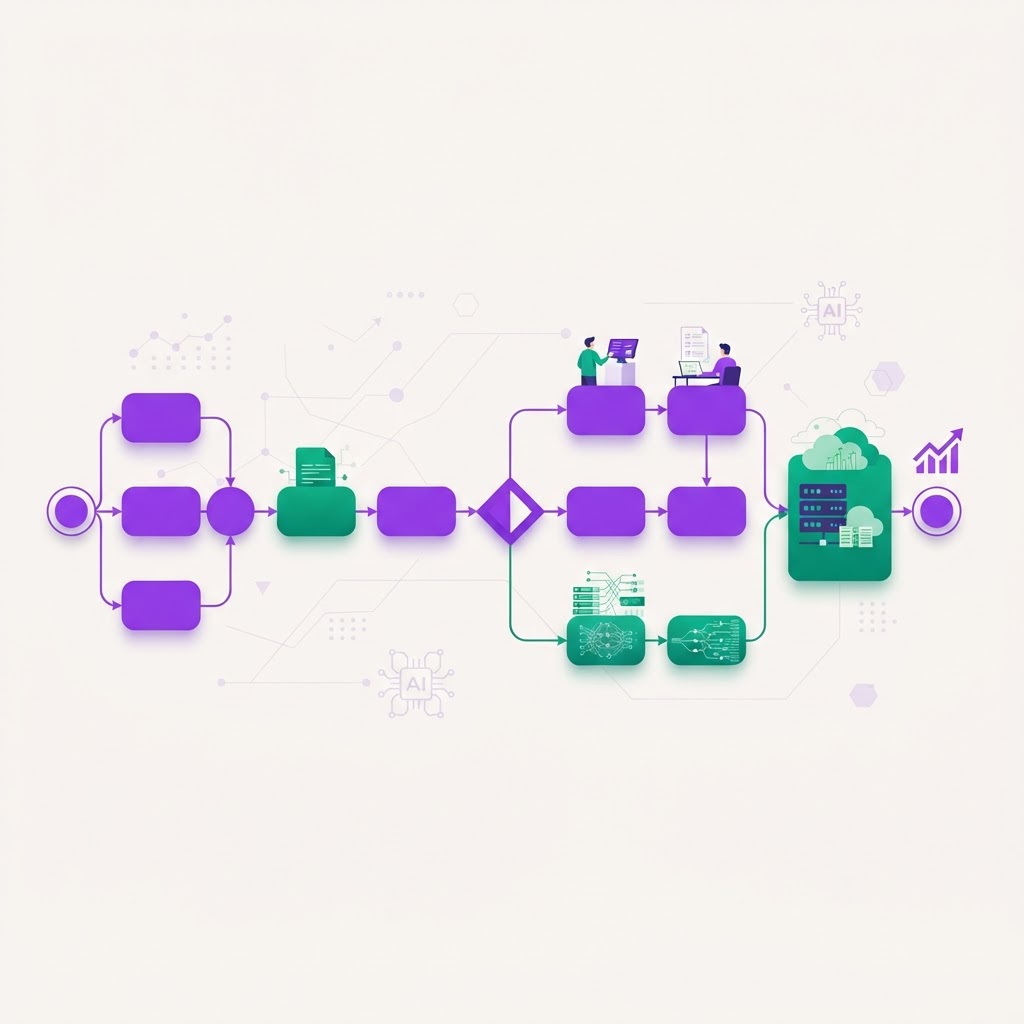
Many business owners view automation as a magic switch that will fix a broken process. In reality, automation is a force multiplier; if you automate a broken process, you simply break things faster. At Agentic Design, we see SMEs rush into implementing AI agents, only to find that the underlying workflow was never clearly defined. Taking one hour to map your process before you write a single line of code is the difference between a project that pays for itself in months and one that stalls indefinitely.
Mapping your current state provides a 'ground truth' that often shocks stakeholders. You might believe your sales team follows a five-step lead qualification process, but the map reveals that they are actually using a hidden spreadsheet, checking three different email threads, and manually copying data into the CRM. Until you see these deviations on paper, you cannot build an agentic layer to fix them. Mapping forces honesty about how work actually happens versus how you think it happens.
The Anatomy of a Workflow Map
To map a process quickly, you do not need expensive software. A whiteboard, a stack of sticky notes, or a simple digital flowchart tool will suffice. Focus on the core components that dictate how data moves through your Australian business. Start with the trigger: what event actually kicks off the work? It could be a new order in your ERP, an incoming invoice email, or a customer service query in your CRM.
Once the trigger is identified, document every step with surgical precision. For each step, ask yourself: what system is being touched, and what decision is being made? An agentic AI layer is designed to sit across these systems—using APIs to pull data from your accounting software, push updates to your CRM, and cross-reference inventory levels in your warehouse—without requiring you to rip and replace your existing infrastructure.
Your map must explicitly account for the following elements:
- The trigger: The initial input that starts the cycle.
- The sequence: The linear steps taken to process the task.
- The decision nodes: Where the process forks based on logic (e.g., if order value exceeds $5,000, trigger manager approval).
- The exceptions: What happens when data is missing or a validation fails?
- The handovers: Where the baton passes from a human to a system, or between departments.
- The systems: Which specific platforms contain the data required for each step.
Identifying the 'Agentic' Sweet Spot
Not every process should be automated, and not every automated process needs an agent. An agentic AI platform is most powerful when it replaces the 'swivel-chair' work: the manual effort of moving data between systems that do not naturally talk to each other. If your mapping session shows a process that involves constant switching between your inventory management system and your accounting package, you have found a perfect candidate for an agent.
Mapping reveals whether you actually need an intelligent agent or just a simple script. If the process is purely linear with zero ambiguity, a standard automation tool will work. However, if the process requires judgment—such as verifying a delivery address against a client profile or flagging a suspicious invoice based on historical patterns—that is where our agentic layer adds value. Agents can handle the nuance that static automations cannot.
Consider a real-world example: an SME managing building supplies. An order comes in via email. Currently, a staff member reads the email, checks the ERP for stock, updates the spreadsheet, and emails the client a confirmation. This takes 15 minutes per order. If the staff member makes a typo in the inventory code, the whole process stalls. An agent can read the email, perform the ERP lookup via API, validate the stock, and send the response in seconds. The mapping process uncovers that the bottleneck isn't the staff member, but the manual verification of stock levels. By isolating that step, you turn a 15-minute manual task into a 30-second automated one.
Why Most Projects Fail Without Mapping
When we engage with clients who have already attempted automation, the failure points are usually consistent. They failed to account for the 'exceptions' in their workflow. Every business has them—those edge cases where a client has a unique payment term, or an inventory item is stored in an offsite warehouse. If these exceptions are not mapped, the agent will encounter them and stop working, forcing a human to step in and fix the mess.
Mapping ensures that your agent is robust enough to handle the 'messy' side of business operations. By documenting these exceptions early, we can program the agent to either handle the edge case automatically or escalate it to a human with a clear summary of why the process reached a stalemate. This transparency is vital. Your staff will trust an agent that knows its limits far more than an agent that guesses incorrectly.
- Define the 'happy path' where everything goes right.
- Document every 'if-this-then-that' scenario that results in a deviation.
- Identify the primary system of record for each piece of data.
- Note any manual data entry that serves no clear purpose.
- List the specific roles responsible for each stage of the handover.
Where to start
-
Select one high-volume, repeatable process that everyone in your office dreads, such as invoice reconciliation or lead onboarding, and block out 60 minutes with the person who actually does the work, not just the manager who oversees it.
-
Use sticky notes to map the process exactly as it happens today, including the 'secret' spreadsheets and manual checks, then circle every step where data is typed from one system into another.
-
Review your map to identify the most repetitive, low-judgment step in that chain; that is your immediate, low-hanging fruit for an agentic implementation that can be delivered in weeks, not months.