Why agentic projects ship in weeks when software projects take a year
By Agentic Design
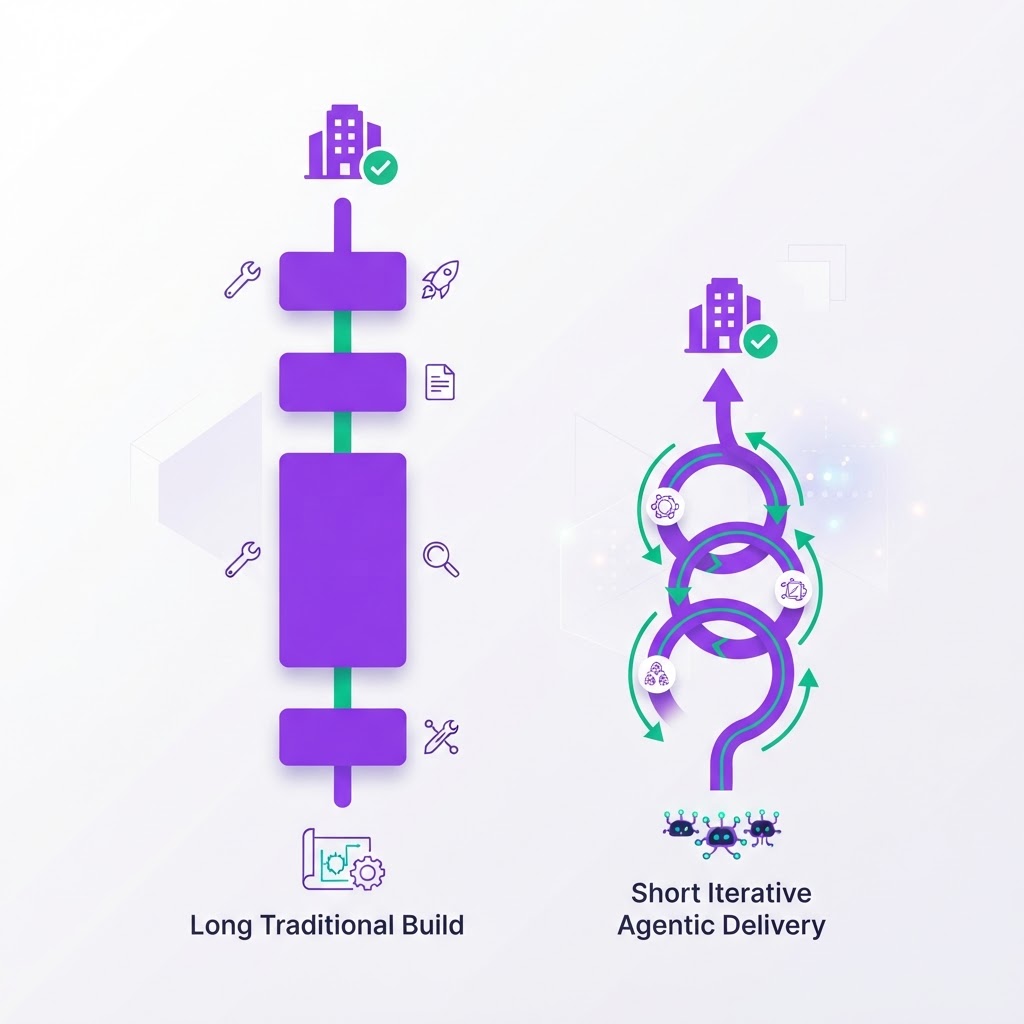
Most Australian business owners view software projects through the lens of trauma. They recall the last time they updated an ERP or migrated a CRM, a process that spanned twelve months, swallowed three times the original budget, and left their staff confused and frustrated. When we suggest that an agentic platform can be fully operational in a matter of weeks, the initial reaction is usually scepticism. However, the difference lies in the architecture of the solution, not the speed of the developers.
The fallacy of core system replacement
Traditional digital transformation projects often start with a dangerous premise: that the existing system is the problem and must be replaced. This mindset triggers a massive overhaul of databases, user permissions, historical data migration, and retraining. It is a fundamental disruption to daily operations that almost guarantees a year of instability. You are effectively performing open-heart surgery while the patient is running a marathon.
Agentic design takes a completely different approach. Instead of replacing your CRM, ERP, or finance software, we build an agentic layer that sits on top of these systems. This layer communicates with your existing tools via APIs, acting as an intelligent conductor for the data that already lives within your infrastructure. Because the core systems remain untouched, there is no risk to the integrity of your historical records or your existing workflows.
Narrow scope equals rapid delivery
Software projects fail when they try to solve everything at once. Attempting to build an 'all-encompassing' dashboard is a recipe for a project that never ends. Agentic projects thrive on narrow, high-impact scopes. We look for a specific, repetitive, data-heavy bottleneck in your business—such as reconciling invoices, managing complex stock replenishments, or triaging customer support tickets—and we build an agentic workflow specifically for that task.
By focusing on a single, well-defined problem, we reduce the complexity of testing and implementation. You do not need to wait for a perfect, enterprise-wide ecosystem to see value. You simply need an agent that reliably handles one process from start to finish. Once that is live, you have immediate ROI, which provides the evidence and momentum to expand the scope to other areas of the business.
The mechanics of the weekly iteration
Traditional development often functions like a black box, where you wait months for a final release. Agentic projects operate on a weekly delivery rhythm. Because the scope is narrow and the platform is standalone, we can build, test, and deploy a functional iteration every seven days. This allows us to refine the agent's logic based on your team's feedback in real-time.
- Week 1: Mapping the existing API endpoints and defining the agent’s decision tree.
- Week 2: Prototype deployment in a sandbox environment to test data accuracy.
- Week 3: Full integration with existing business processes and error handling.
- Week 4: Final tuning, user verification, and transition to live monitoring.
This velocity is only possible because we use AI-assisted development tools that accelerate the coding process for API connections and logic checks. We spend less time writing boilerplate code and more time ensuring the agent follows your specific business rules correctly.
What still takes time
It is important to be honest: not everything happens at the speed of a keyboard. While the coding is fast, the 'human' work of defining clear business logic still requires rigour. An agent is only as good as the instructions it follows. If your internal processes are undocumented or rely on 'tribal knowledge' that nobody has written down, we must spend time codifying that knowledge before we can build the agent.
Furthermore, setting up secure, authenticated API access to your legacy systems can sometimes be delayed by internal IT security requirements or the limitations of older software. We cannot control how quickly your finance software grants us API access, or how long your IT department takes to review security protocols. These are the practical realities that add time to the schedule, and we account for them by starting those conversations on day one.
Why this model works for Australian SMEs
Australian SMEs do not have the luxury of multi-year timelines or the budget to absorb massive integration failures. You need tools that work today, integrate with the software you have already paid for, and provide immediate efficiency gains. An agentic layer is essentially a digital employee that handles your most tedious, logic-driven tasks without needing to change your entire organisational structure.
- It provides immediate, measurable ROI within the first month.
- It minimises disruption because it does not change your existing core software interfaces.
- It offers flexibility to scale; you can start with one agent and add more as you grow.
- It creates a scalable, repeatable way to handle business growth without needing to hire more administrative staff.
By focusing on integration rather than replacement, we shift the project from a high-risk gamble to a low-risk, high-reward upgrade. We are not asking you to throw away your current systems; we are asking you to make them work harder for you.
Where to start
If you want to see this in action, follow these three steps to identify your first candidate for an agentic project:
- Identify one administrative task that takes your team more than five hours per week but requires little 'creative' judgment.
- Verify that the software used for this task has an API or can export data in a structured format like CSV or JSON.
- Document the specific 'if this, then that' rules your team uses to make decisions during that process.