Wholesale and distribution: agents for order intake, pricing and backorders
By Agentic Design
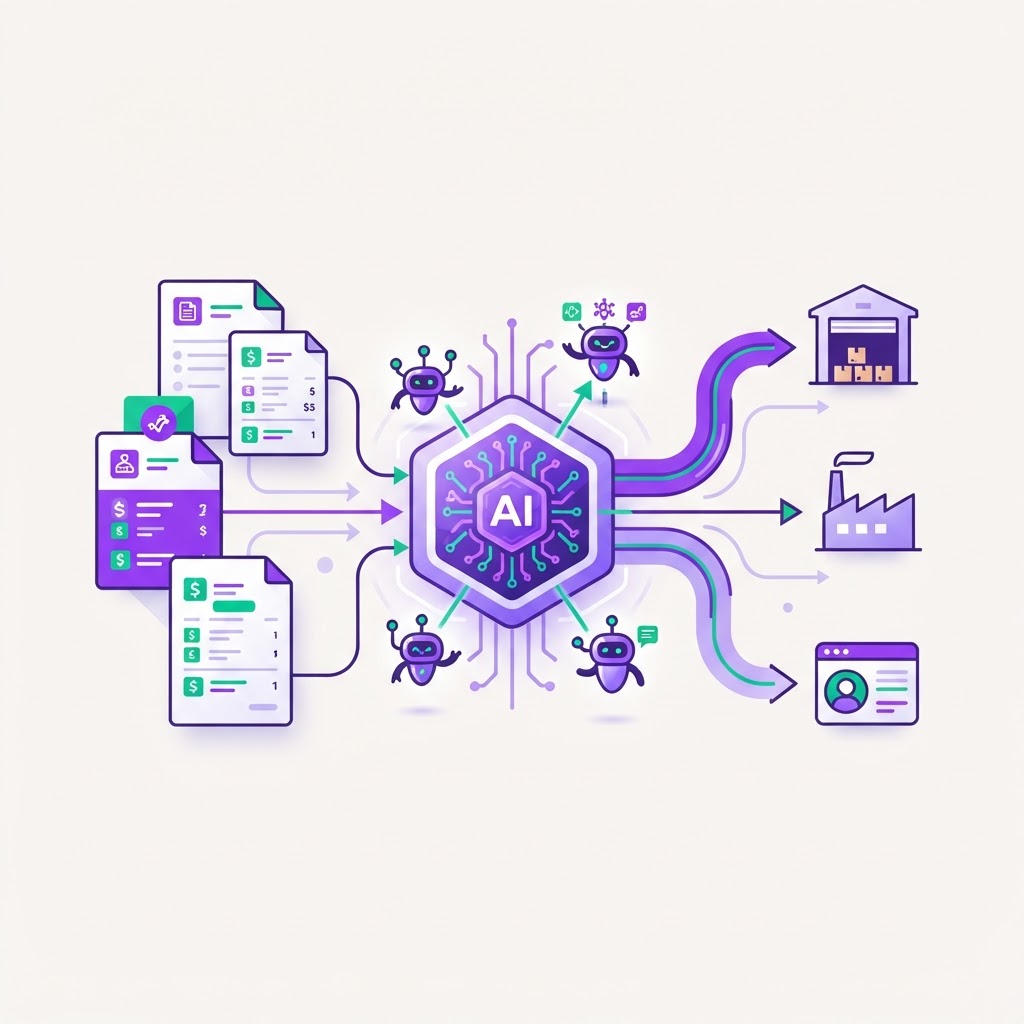
For many Australian wholesalers, the gap between a customer sending an order and that order landing in your ERP is a productivity black hole. You likely have a team manually transcribing data from emails, PDFs, and spreadsheets into your core system, only to spend more time checking pricing against individual customer contracts or chasing backorder status updates. This manual overhead is not just an administrative burden; it is a bottleneck that prevents your business from scaling.
Agentic Design approaches this differently. Instead of asking you to rip out your legacy ERP or CRM, we build an agentic layer that sits on top of your existing systems. By leveraging APIs, this layer acts like a digital employee capable of reading, deciding, and acting across your software stack. It bridges the divide between your inbox, your inventory, and your finance system without requiring a multi-year digital transformation project.
Automating the order intake bottleneck
Order intake is the most repetitive task in the wholesale lifecycle. Whether it arrives via a scanned PDF, a handwritten photo of a purchase order, or a semi-structured email, the information needs to be structured and validated against your live inventory. An agentic platform can monitor your generic sales inboxes, extract relevant data points like SKU numbers, quantities, and delivery dates, and map them directly into your ERP.
Unlike traditional OCR tools that simply convert images to text, an agentic layer performs context-aware processing. It checks if the item code exists, validates the customer's identity, and flags inconsistencies. If a customer orders 50 units but the item is discontinued, the agent doesn't just jam the order into your system; it triggers a predefined workflow to notify the customer or suggest a substitute.
Dynamic customer-specific pricing
One of the greatest complexities in Australian wholesale is maintaining individual pricing agreements. You might have a base price list, but your major accounts likely have specific volume discounts, tiered structures, or special promotional pricing. In manual environments, errors here lead to margin leakage or, worse, customer disputes that damage long-term relationships.
An agentic platform integrates with your finance system and CRM to verify pricing in real-time during the intake process. When an order arrives, the agent validates the requested price against the latest contract stored in your system. If the requested price deviates from the agreed-upon rate, the agent can either auto-correct the entry based on logic you provide or flag it for a sales manager’s approval before the order is committed to the warehouse.
Managing backorders and proactive communication
Backorders are an inevitable reality of global supply chains, but the way you communicate them defines your reliability as a wholesaler. When inventory levels drop below a certain threshold, the typical process involves checking spreadsheets, calling the warehouse, and then manually emailing the customer. This reactive cycle is slow and often results in unhappy clients who are left in the dark until the delivery date passes.
With agentic automation, backorder management becomes a proactive service. When an order is processed, the system automatically checks current stock levels and incoming shipment arrival dates. If a product is unavailable, the agent generates a polite, personalized email to the customer explaining the delay and providing the expected restock date, all based on data pulled directly from your inventory software.
- Proactive inventory alerts sent automatically to customers upon order confirmation.
- Real-time sync between warehouse stock levels and customer-facing communication.
- Automatic generation of ETA reports for high-priority client accounts.
Handling credit, returns, and compliance
Returns and credit requests are another area where human intervention is often redundant. A standard request for a credit note usually follows a predictable path: verification of the original invoice, assessment of the return reason, and approval against your internal policy. By digitizing this workflow, you can reduce the time taken to process a return from days to hours.
An agentic platform can verify if a return request falls within the warranty period by cross-referencing the purchase date in your finance module. It can then initiate a draft credit note or send a return authorization form to the customer. This ensures that your credit policy is applied consistently and that the finance team only touches the transactions that require actual human judgment.
- Automated verification of warranty periods using invoice data integration.
- Standardized approval workflows for credit notes that trigger automatically.
- Reduced administrative latency in warehouse returns processing.
The reality of agentic deployment
Many SME owners worry that implementing AI will take months of planning and significant capital expenditure. Because an agentic layer interacts with your existing software via APIs, the implementation timeline is measured in weeks, not years. We focus on connecting the specific nodes of your infrastructure—your ERP, CRM, and communication channels—to create a unified, responsive operation.
This approach reduces the risk of disruption. You keep the systems that already hold your financial history and inventory data, while the agentic layer provides the connectivity and intelligence required to make those systems work together. By removing the manual 'data-shovelling' from your team's day-to-day tasks, you free them to focus on high-value activities like relationship management and business development.
Where to start
To move forward, focus on these three concrete steps:
- Map your most manual order intake process: Identify which channel (email, portal, or PDF) takes the most time and requires the most data entry, as this is your best candidate for initial automation.
- Audit your API documentation: Ensure your current ERP and CRM providers offer accessible API endpoints so our platform can securely read and write data to your systems.
- Define your exception logic: Write down the top three reasons why an order currently fails or requires manual intervention, as these rules will form the foundation of your initial agentic workflows.