Where does the data live? Governance for agentic platforms across your stack
By Agentic Design
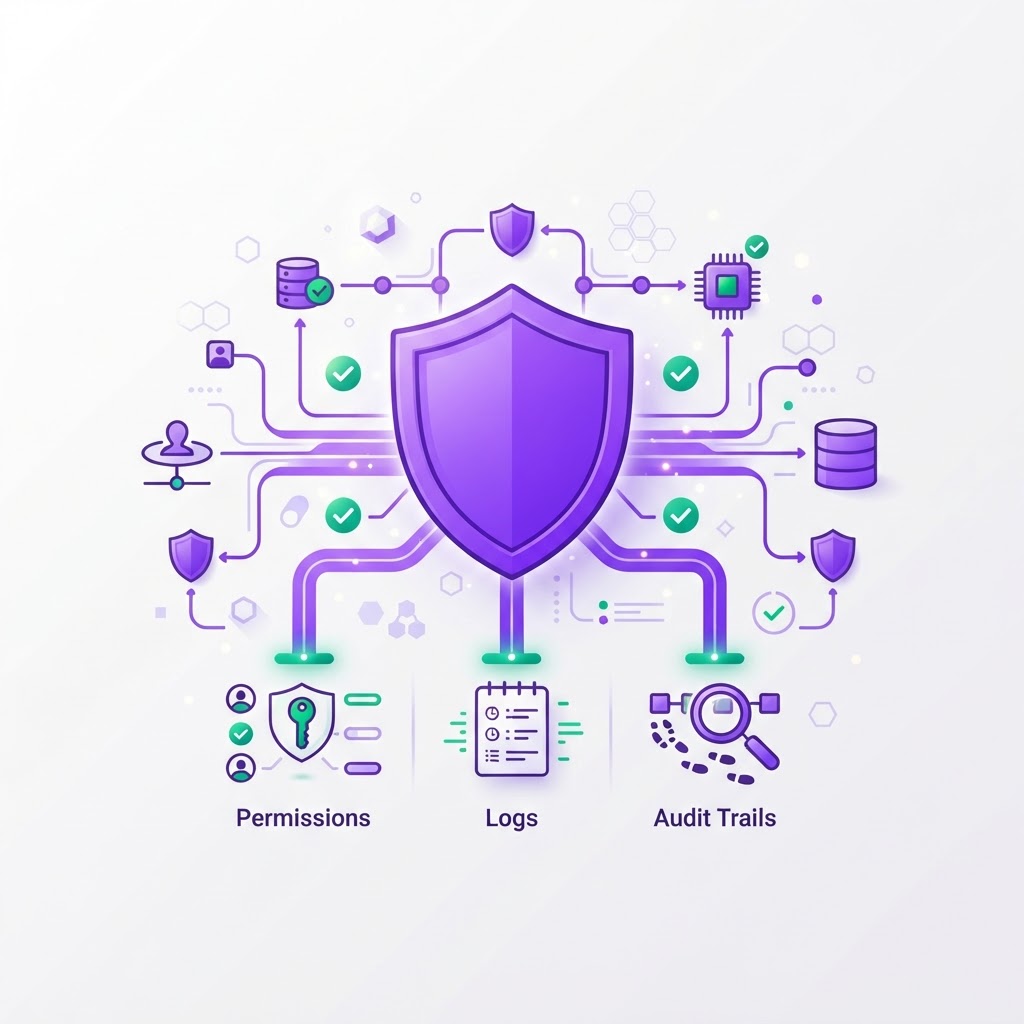
When you introduce an AI agent to your business, you are essentially hiring a digital employee that never sleeps. Unlike a human, this agent does not work inside a silo; it sits on top of your existing infrastructure, pulling data from your CRM, pushing updates to your inventory system, and reconciling invoices in your accounting platform. Because this agentive layer interacts with every part of your business, the question of where your data lives is no longer just an IT concern—it is a foundational business risk and governance issue.
Understanding the agentic layer
Many SME owners worry that adopting AI means migrating their entire business to a new, opaque ecosystem. That is not how a modern agentic platform works. Instead, think of it as a central nervous system that connects to your existing software via secure pathways called APIs. Your data stays exactly where it has always lived—in Xero, Salesforce, Shopify, or your local file servers. The agent does not 'own' or 'host' your data in the traditional sense; it acts as a highly efficient messenger and processor that operates only when you authorise it to do so.
Data residency and sovereignty
For Australian businesses, data residency is non-negotiable. Whether you are dealing with sensitive customer medical records or internal financial forecasts, you need to know that your data is not bouncing through unsecure international servers. A professional agentic platform should allow you to pin your data processing within Australian-based cloud regions. This ensures that your operational data remains under the jurisdiction of Australian privacy laws, providing you with a clear audit trail and peace of mind when it comes to compliance.
Implementing least-privilege access
One of the most dangerous mistakes an SME can make is granting an AI agent 'admin' level access to every system. This is equivalent to giving a new hire the keys to the safe, the server room, and the payroll account on their first day. Governance requires the principle of least-privilege access. This means the agent should only have the specific permissions required to perform its task, such as reading an invoice amount, without having the authority to change bank details or export your entire client database.
- Restrict the agent's ability to delete records in your CRM.
- Limit read access to only the specific data fields needed for a task.
- Require distinct API keys for every system the agent touches.
- Disable cross-system file movement unless explicitly triggered by a human.
Handling PII and sensitive information
Protecting Personally Identifiable Information (PII) is the bedrock of your reputation. When an agent interacts with customer data, it should be designed to sanitise or mask information that it does not need to see. For example, if an agent is tasked with summarizing customer support tickets for a weekly report, it can be programmed to strip names, email addresses, and phone numbers before it even begins the analysis. By keeping PII out of the reasoning process, you significantly reduce the risk of accidental exposure.
Audit logs and transparency
If something goes wrong—or if you simply want to understand why a decision was made—you need an audit log. A robust platform keeps a granular record of every action the agent takes. You should be able to see exactly when the agent accessed a file, which system it communicated with, and what information it retrieved. This is not just for technical debugging; it is your record of truth for accountability and process improvement.
Human-in-the-loop approvals
Total automation sounds efficient, but it can create blind spots. The most effective way to govern agentic platforms is to implement human-in-the-loop workflows for high-stakes decisions. If an agent is preparing a bulk email campaign to ten thousand customers or finalising a payment run of over $5,000, the system should pause and push a notification to your mobile device. You review the summary, click 'Approve,' and only then does the action proceed. This approach allows you to scale your operations without losing control over the final outcome.
How to review agent behaviour
Governance is not a 'set and forget' process. You should schedule a monthly review of the agent's performance, just as you would evaluate a staff member. During these reviews, check the following:
- Compare the agent's task completion logs against your expectations.
- Audit the error rate—is the agent struggling with specific data formats?
- Review any triggers that required a human override to see if the process needs tweaking.
- Evaluate if any access permissions are now redundant and should be revoked.
By treating your agentic platform as a partner rather than a black box, you ensure that your business remains agile without compromising the security of your critical assets. You retain the strategic control, while the agent handles the repetitive heavy lifting that keeps your business moving.
Where to start
- Conduct a permissions audit by listing every system your agent currently accesses and checking if it has the absolute minimum access required to function.
- Enable mandatory human-in-the-loop approvals for any automated tasks involving external payments or mass customer communication.
- Verify your data residency settings with your provider to ensure that all processing and storage occur within Australian sovereign cloud environments.