What agentic AI costs to run, honestly
By Agentic Design
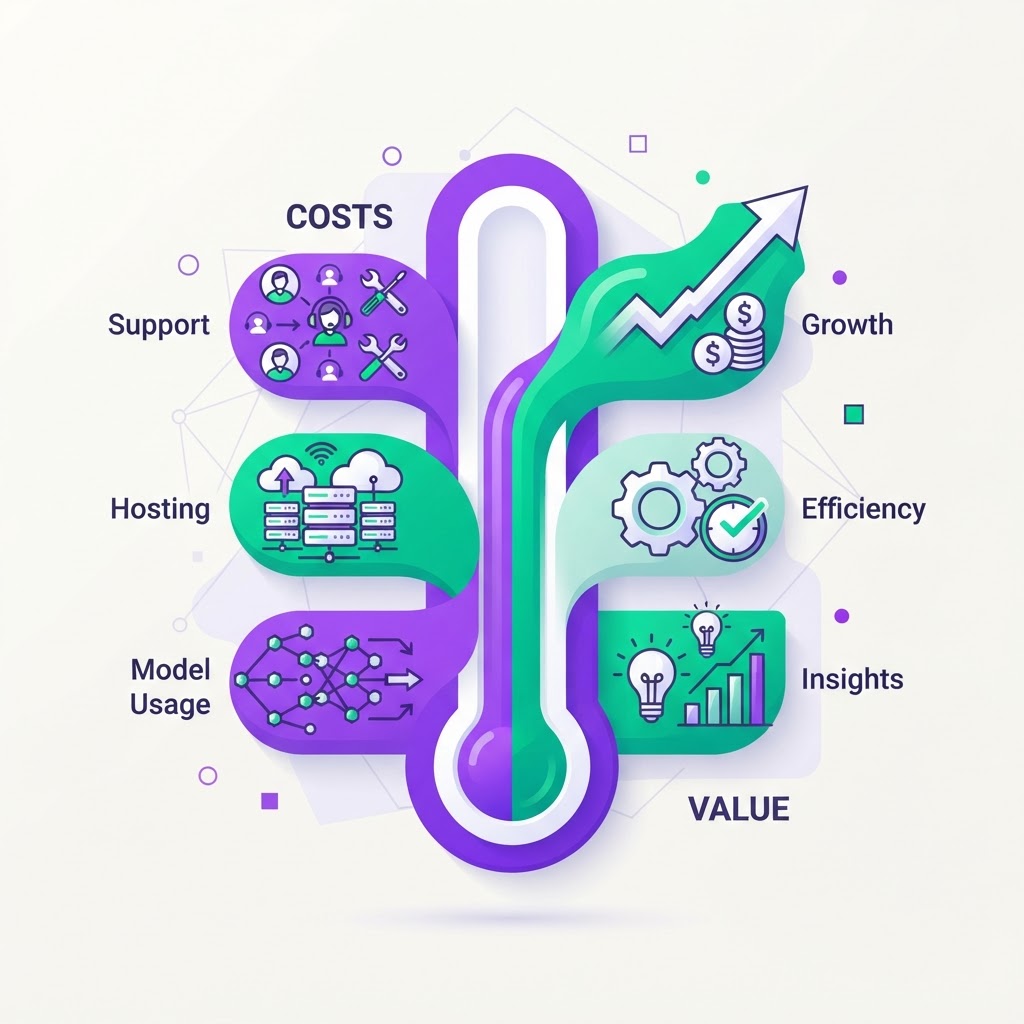
For Australian SME owners, the shift toward agentic AI is often framed as a technology revolution, but it is fundamentally an operational finance decision. Unlike simple software subscriptions, agentic AI operates as an autonomous layer that connects your existing CRM, ERP, and inventory systems to execute tasks. Because these agents make decisions rather than just triggering pre-set rules, the costs are dynamic rather than fixed. Understanding these expenses is the first step in moving from pilot testing to a profitable, scalable business strategy.
The anatomy of your AI cost base
When we deploy an agentic layer across your existing business systems, your monthly invoice consists of four distinct pillars. The most obvious is model inference, which is the cost paid to the AI provider for every "thought" or action taken by the agent. This is measured in tokens, representing chunks of text or data processed. If your agent is reading through your customer service emails, every character processed incurs a marginal cost.
Hosting and infrastructure costs follow. Even though the agentic layer is lightweight, it requires secure, low-latency compute resources to manage API calls between your platforms. You are essentially paying for the digital connective tissue that allows your ERP to talk to your marketing suite. Without a reliable host, your agent risks timing out or failing during critical business processes.
Integration maintenance is the silent killer of project budgets. Your internal systems, such as Xero, Salesforce, or Shopify, update their APIs regularly. Every time a vendor updates their documentation, your agentic layer requires a tune-up to ensure it doesn't break. This is why we advocate for robust middleware rather than fragile, one-off scripts.
Finally, monitoring and human-in-the-loop oversight represent your administrative overhead. You need tools to track agent performance, logs to audit decisions, and human intervention points to approve high-value transactions. This isn't just a cost; it is your insurance policy against an agent making a mistake with your inventory or customer data.
How to forecast and control spending
Forecasting the cost of an agentic layer starts with your transaction volume. You must audit your current processes to define exactly what constitutes a 'unit of work.' If you are automating invoice processing, a single invoice is one unit. If you are handling customer inquiries, a completed ticket cycle is the unit.
- Establish a baseline cost per process before applying AI.
- Set hard caps on model token usage for individual agents to prevent runaway costs.
- Utilize batch processing during off-peak hours for non-urgent tasks to access cheaper compute tiers.
- Implement tiered escalation where simple tasks are handled by low-cost models and complex reasoning is reserved for premium models.
By layering these controls into the architecture, you turn a variable cost into a predictable utility expense. We see many SMEs start by over-provisioning their models, thinking they need the most powerful intelligence for every task. In practice, 80% of business tasks, such as data entry or simple lookups, can be handled by smaller, highly efficient models that cost a fraction of the flagship versions.
Reducing cost per transaction over time
True efficiency comes from refining the prompts and the workflows rather than just swapping models. Every time an agent makes a mistake, it costs you twice: once for the initial action and once for the human time required to correct it. By narrowing the scope of your agents to specific, high-intent tasks, you reduce the 'noise' the model has to process, which in turn reduces token consumption.
Caching frequently requested data is another vital strategy for cost reduction. If your agent needs to check stock levels, it shouldn't query the ERP every single time if the data only updates hourly. By implementing a local cache, you satisfy most agent requests with existing, low-cost data, reserving expensive API calls for when the information is truly time-sensitive.
- Focus on agent 'specialisation' rather than general-purpose bots to keep prompt lengths short.
- Use structured data outputs to ensure the agent spends fewer tokens on formatting and conversational filler.
- Regularly review the failure logs to identify where agents are 'looping' or making redundant queries.
- Maintain a local repository of successful process workflows to train the agent to be more efficient in its decision-making steps.
It is also essential to negotiate your API access. As your transaction volume grows, the marginal cost per API call across your CRM or ERP can become a point of negotiation. If your agent is driving high traffic, ensure your platform provider is helping you manage your consumption quotas effectively.
The reality of implementation timelines
Because we build the agentic layer to sit on top of your existing systems rather than replacing them, implementation is surprisingly fast. We don't spend months migrating your data or training new staff on complex interface changes. Instead, we plug into the APIs you already use and begin orchestrating workflows.
This approach shifts the investment from capital expenditure to operating expenditure. You are not buying a new platform to rip out your finance system; you are adding an intelligence layer that makes your current stack more productive. The cost of implementation is largely front-loaded in the configuration phase, where we map your specific business logic and safety guardrails, but the ongoing maintenance is predictable.
Where to start
- Map your high-volume, repetitive digital processes and document the total time a human currently spends on each task.
- Choose one specific workflow, such as accounts payable reconciliation or lead qualification, as a proof-of-concept rather than trying to automate the entire business at once.
- Run a 14-day audit on that specific process to log every touchpoint where data moves between systems, which will give us the baseline for your agentic ROI.