The 'Agent-First' Audit: Why Your 2027 Roadmap Should Distinguish Between Workflow Automation and Agentic Tasks
By Agentic Design
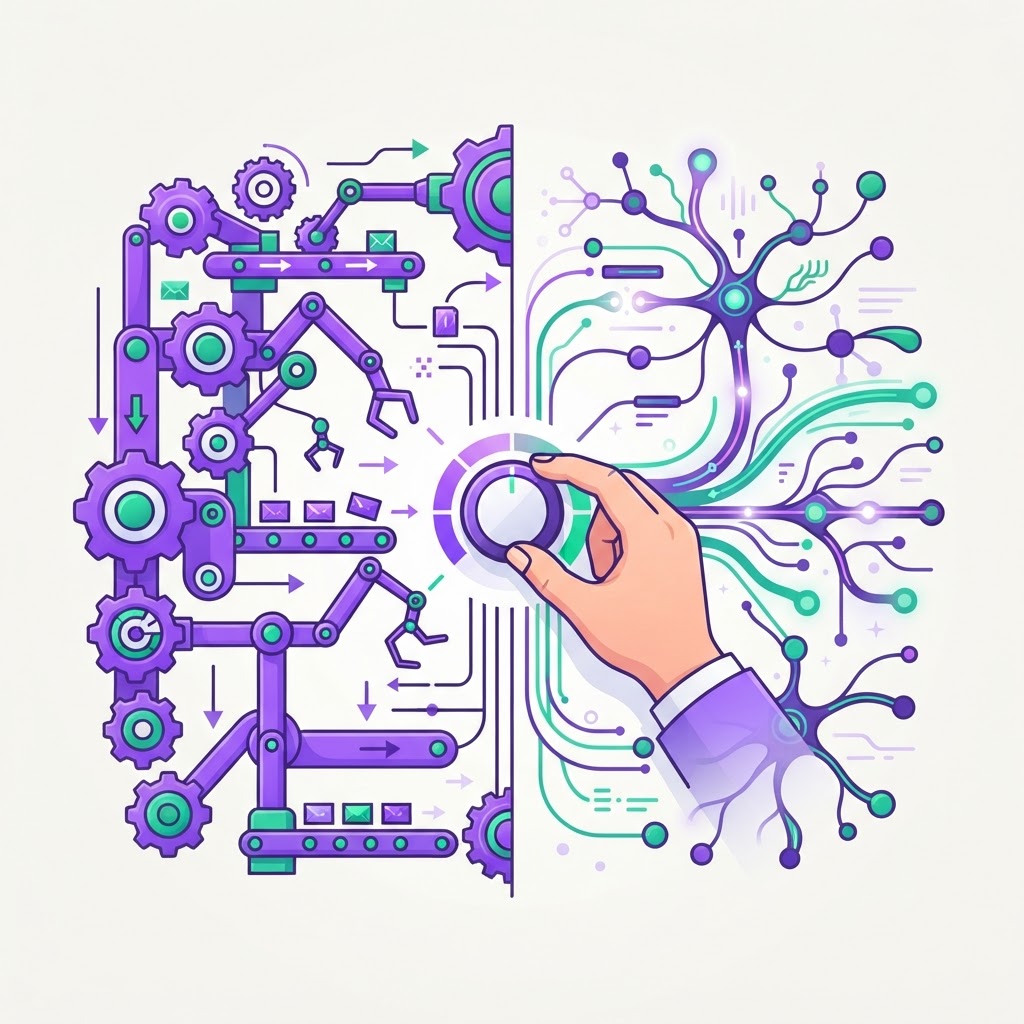
As we look toward 2027, the conversation in Australian boardrooms has shifted from 'can we automate this?' to 'should a human or an agent own this outcome?' If your current roadmap treats all AI tools as a single bucket, you are likely leaving productivity on the table while risking unnecessary operational complexity. It is time for an 'Agent-First' audit.
The fundamental divide
To build a resilient strategy, you must distinguish between workflow automation and agentic tasks. Workflow automation is essentially digital plumbing. It is rigid, rule-based, and follows a linear 'if-this-then-that' logic. Think of automated invoicing, data entry, or scheduled reporting. It is perfect for consistency, but it lacks any capacity to handle the unexpected.
Agentic tasks, however, operate in the realm of autonomy. An agent is given a goal—not just a set of instructions—and it works through obstacles to reach that outcome. If an API call fails or a client document is missing a specific detail, an agentic system can pivot, research, or ask for clarification. It does not just follow the map; it helps you navigate the terrain.
Why the distinction matters for your bottom line
Many businesses are over-investing in complex automation that breaks the moment a process shifts. By auditing your roadmap, you can identify where you need strict, predictable workflows and where you need flexible, agent-driven support. Focusing on agents allows your senior staff to stop managing tasks and start managing outcomes.
- Automate your high-volume, low-variability tasks to ensure total reliability.
- Deploy agents for complex, high-variability workflows where judgment is required.
- Audit your existing tools to see if they are brittle automations disguised as AI.
- Shift your talent focus from manual execution to 'agent supervision' and strategy.
Running your audit
Start your 2027 planning session by mapping your core business processes on a simple grid. On one axis, measure the variability of the input; on the other, measure the complexity of the required decision-making. If a process requires minimal input variability but significant decision-making, that is your primary candidate for an agentic overhaul.
Avoid the trap of trying to force an agent to do everything. Sometimes, a simple, rock-solid script is far more valuable than a sophisticated AI agent that requires constant babysitting. Your goal is to build a hybrid environment where automation handles the 'what' and 'how,' while your agents handle the 'why' and 'what if.'
A confident path forward
For Australian founders and leaders, the goal of 2027 should be clarity. We do not need more tools; we need better architecture. By separating your tasks into these two categories, you will find it much easier to deploy capital effectively and reduce the technical debt that plagues many digital transformation projects. Take the time now to audit your roadmap, and you will be miles ahead of the competition when the market shifts.