Rostering and scheduling agents: cutting cost while improving coverage
By Agentic Design
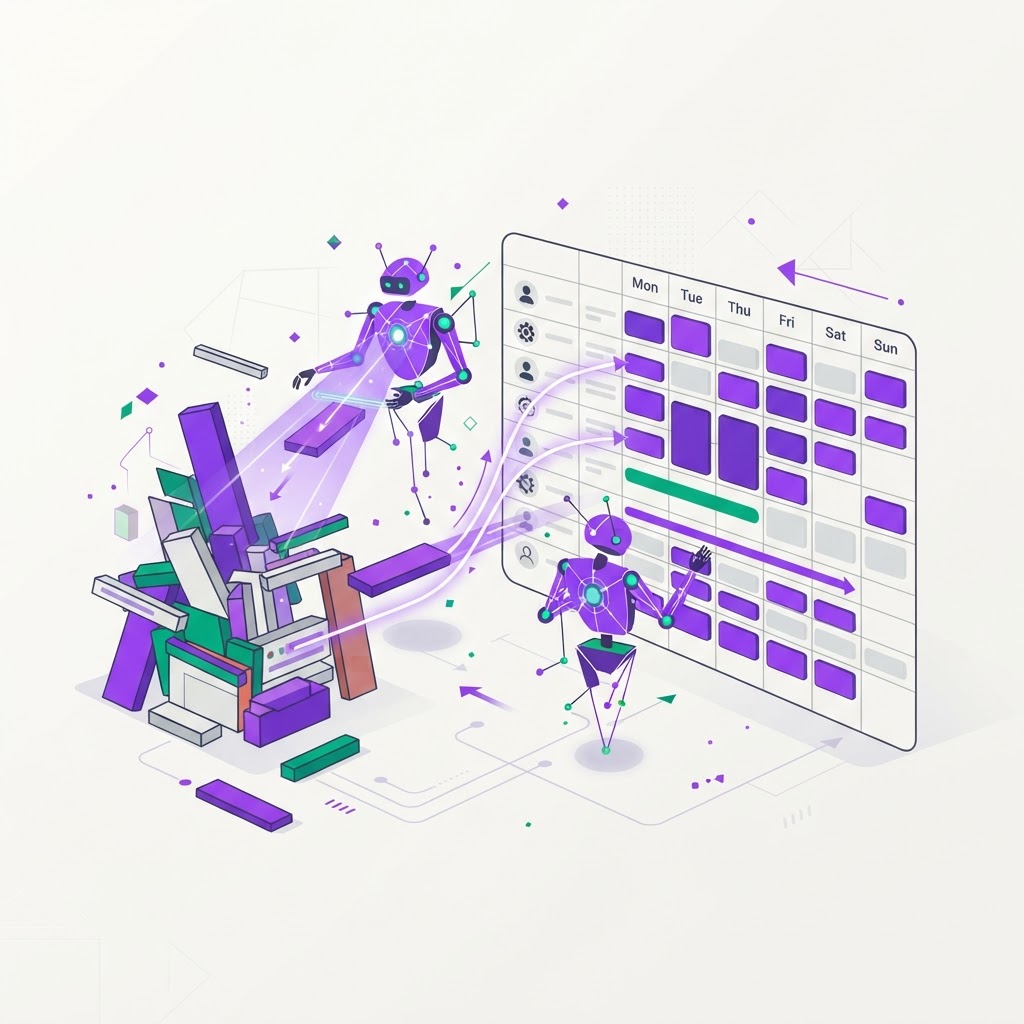
For many Australian small to medium enterprise owners, the weekly roster is a source of constant administrative dread. Balancing staff availability, individual preferences, and the labyrinthine requirements of the Fair Work Act—specifically the nuances of the Hospitality Industry General Award or the General Retail Industry Award—is a high-stakes puzzle that rarely stays solved for long. When you factor in last-minute call-outs and fluctuating customer demand, the traditional spreadsheet approach or static scheduling software often breaks down, leading to either excessive overtime costs or dangerous coverage gaps.
Agentic AI changes the paradigm by acting as a connective layer that sits across your existing infrastructure. Unlike rigid legacy software, an agentic platform reads data from your CRM, your point-of-sale system, your payroll software, and your inventory records simultaneously. It does not replace these systems; it makes them talk to each other to perform the work that currently occupies your management team for hours every week.
The cost of manual constraint management
Manual rostering is inherently reactive. A manager sitting in an office trying to balance a roster is limited by the information they can hold in their head. They might remember that Dave is a great closer, but they might miss the fact that Sarah has hit her maximum ordinary hours for the cycle, triggering costly overtime rates. These small errors ripple through your payroll, often costing SMEs thousands of dollars annually in unnecessary penalty rate payments.
Guesswork is the enemy of efficiency. When a shift becomes vacant due to an emergency, the human response is typically to call the first person who springs to mind. An agentic agent, by contrast, performs real-time constraint optimisation. It immediately evaluates every eligible staff member against current award conditions, their current weekly hours, their distance from the store, and their specific skill certification. This takes milliseconds, not the twenty minutes of phone tag that typically follows a staff absence.
Moving beyond static scheduling
Traditional scheduling software is often little more than a digital whiteboard; it holds the roster, but it doesn't understand the business. Agentic platforms are different because they are 'award-aware'. By integrating directly with your payroll system, the agent understands the specific cost implications of every shift it assigns. It treats labour as a variable cost that needs to be optimised against your predicted revenue, rather than a fixed cost you simply hope to manage.
Consider the practical application in a retail setting during a peak trade period. The agent observes a 20% spike in customer foot traffic data from your POS and automatically suggests extending a shift or adding a midday resource. Crucially, it calculates the cost of that additional hour against the projected revenue lift, ensuring that you aren't just adding labour for the sake of it, but adding it where it translates directly to the bottom line.
- Real-time automated shift-fill alerts sent directly to eligible staff mobile devices.
- Dynamic adjustment of rosters based on live inventory replenishment cycles or delivery windows.
- Automated cross-referencing of staff qualifications to ensure shift compliance.
The reality of last-minute changes
Last-minute changes are the biggest disruptor to SME productivity. When someone calls in sick, the impact is three-fold: immediate service degradation, management distraction, and the high likelihood of a costly, rushed replacement. An agentic layer manages this by having a pre-verified pool of staff who have already opted into a secondary availability list.
- The agent initiates a broadcast offer to all qualified staff who are currently under their award-mandated rest periods.
- It automatically updates the roster and notifies payroll the moment a replacement accepts, eliminating the need for manual data entry.
- It logs the change in your existing ERP, ensuring that stock levels or floor coverage targets remain updated in real-time.
This approach removes the emotional friction of managing staff schedules. Instead of a manager needing to 'ask' a staff member for a favour, the agent presents an opportunity that adheres strictly to the law and your internal budget. It transforms a crisis into a routine transaction.
Integration without the headache
One of the most common hesitations SME owners have regarding new technology is the fear of another 'system implementation' that takes six months and requires extensive training. An agentic platform is designed to sit alongside your current stack. Because it works through API connections to the tools you already use, you do not need to migrate your data or retrain your team on a new interface. It acts as an autonomous layer that handles the heavy lifting, delivering ROI in a matter of weeks rather than years.
When we deploy these systems for Australian SMEs, we typically see a 10 to 15% reduction in payroll leakage within the first quarter. This isn't achieved by cutting staff, but by eliminating the 'accidental' overtime and scheduling inefficiencies that occur when humans try to manage complex data sets manually. You regain control over your overheads while simultaneously improving the reliability of your service for your customers.
Where to start
- Audit your current 'leakage' points by reviewing the last three months of payroll data to identify how much you spent on overtime that wasn't strictly necessary for coverage.
- Map your current data sources—specifically where your staff availability, pay rates, and sales forecasts live—to see how easily they can be accessed via an API connection.
- Run a two-week pilot focusing strictly on shift-fill automation for a single department to measure the reduction in management hours spent on the phone.