Prompting is not the product: why agent design matters more
By Agentic Design
Most Australian businesses are currently trapped in a cycle of what we call 'prompt-chasing'. You find a task, you write a clever prompt, and you feed it into a large language model. For a week, it feels like magic. Then, the model produces a hallucination, fails to retrieve the correct data from your Xero account, or simply ignores a specific instruction when the input data changes slightly. The magic evaporates, and you are left with a broken workflow that requires more manual supervision than the original process you sought to automate.
The fallacy of the prompt-only approach
Prompt engineering is a vital skill, but it is not an architecture. A prompt is merely a set of instructions given to a black box. If your SME relies on prompts alone, you are expecting a single text string to handle state management, error logging, authentication, and logical reasoning simultaneously. This is akin to trying to run an entire logistics company using only handwritten notes passed between drivers. It lacks structure, accountability, and reliability.
When you build an agentic system, you stop treating AI as a creative writing assistant and start treating it as a digital employee. An employee does not succeed based on a single instruction; they succeed because they have access to tools, clear processes, and a feedback loop. Your AI agent needs to be able to query your CRM for a customer's history, check your inventory levels in real-time, and draft an invoice—all while confirming each step against business rules.
Moving from prompts to orchestration
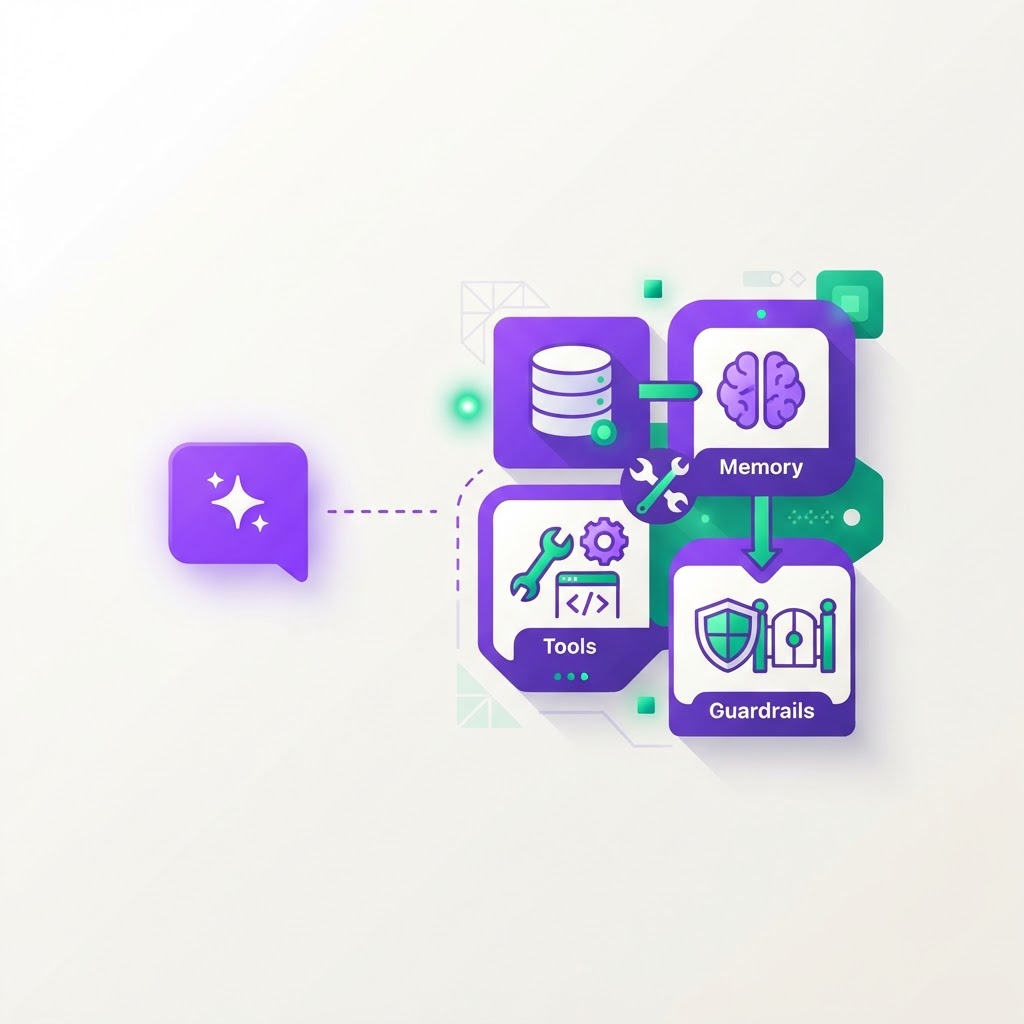
True agentic design is about the orchestration layer. This layer sits between your LLM and your existing tech stack—your CRM, ERP, finance software, and spreadsheets. Instead of asking an AI to 'guess' the right answer, you provide it with an API-connected toolkit. If the agent needs to update a customer record, it executes a specific, pre-defined function that writes directly to your database. This eliminates the chance of the AI inventing a fake transaction record.
By building an agentic layer that integrates across your systems, you maintain the source of truth. The AI does not replace your ERP; it acts as a high-speed operator that navigates it for you. This allows for complex, multi-step operations that were previously impossible to automate. For example, an agent can be triggered by an incoming email to:
- Verify the sender's current account standing in your finance software.
- Cross-reference stock levels in your inventory system.
- Draft a response that includes real-time pricing and delivery availability.
- Log the interaction back to your CRM for record-keeping.
The non-negotiables: guardrails and evaluation
Production-grade agentic platforms require rigorous guardrails. Without these, you are leaving your business operations to chance. Guardrails are the 'rules of the road' that the agent cannot cross. They check the AI's logic before a final action is taken. If an agent proposes a discount that exceeds your pre-set 10% limit, the guardrail stops the process and alerts a human manager. This provides the safety net needed to deploy AI in high-stakes environments like finance and procurement.
Equally important is the evaluation framework. How do you know if your agent is actually doing its job? You need a system that benchmarks performance. We look at three specific metrics for our clients:
- Success rate of function calls: Did the agent correctly execute the API request?
- Human intervention frequency: How often does an employee need to step in to fix a process?
- Data accuracy: Does the agent's output match the actual values retrieved from the source system?
Handling errors in real-time
No system is perfect, and failures will occur. When an API goes down or an LLM returns an ambiguous result, your agent needs an error handling strategy. A prompt-only solution will simply 'crash' or output gibberish. An agentic platform, however, is designed to retry connections, escalate to a human, or roll back a transaction if an error occurs. This resilience is the difference between a prototype and a production-ready business system. Your agent should be able to identify when it is stuck and request help, rather than blindly continuing down a path of failure.
Building this capability does not need to take years of R&D. Because we build on existing infrastructure, we are not rewriting your software. We are adding a cognitive layer that connects your data silos. This approach allows us to deliver functional agentic platforms for SMEs in a matter of weeks, not months. You get the benefits of enterprise-level automation without the enterprise-level price tag or the need to replace your current operational stack.
Where to start
If you are ready to move beyond basic prompting, these are your first three steps. First, map out one high-frequency process that involves two or more different pieces of software, such as moving data from an email order into your inventory system. Second, define the 'failure state' for that process; identify exactly what information the agent must have to be 100% accurate. Third, engage with a platform approach that prioritises API integrations over conversational flair. Focus on connectivity and reliability, and the efficiency gains will follow.