Professional services: where agentic AI actually saves accountants, consultants and agencies time
By Agentic Design
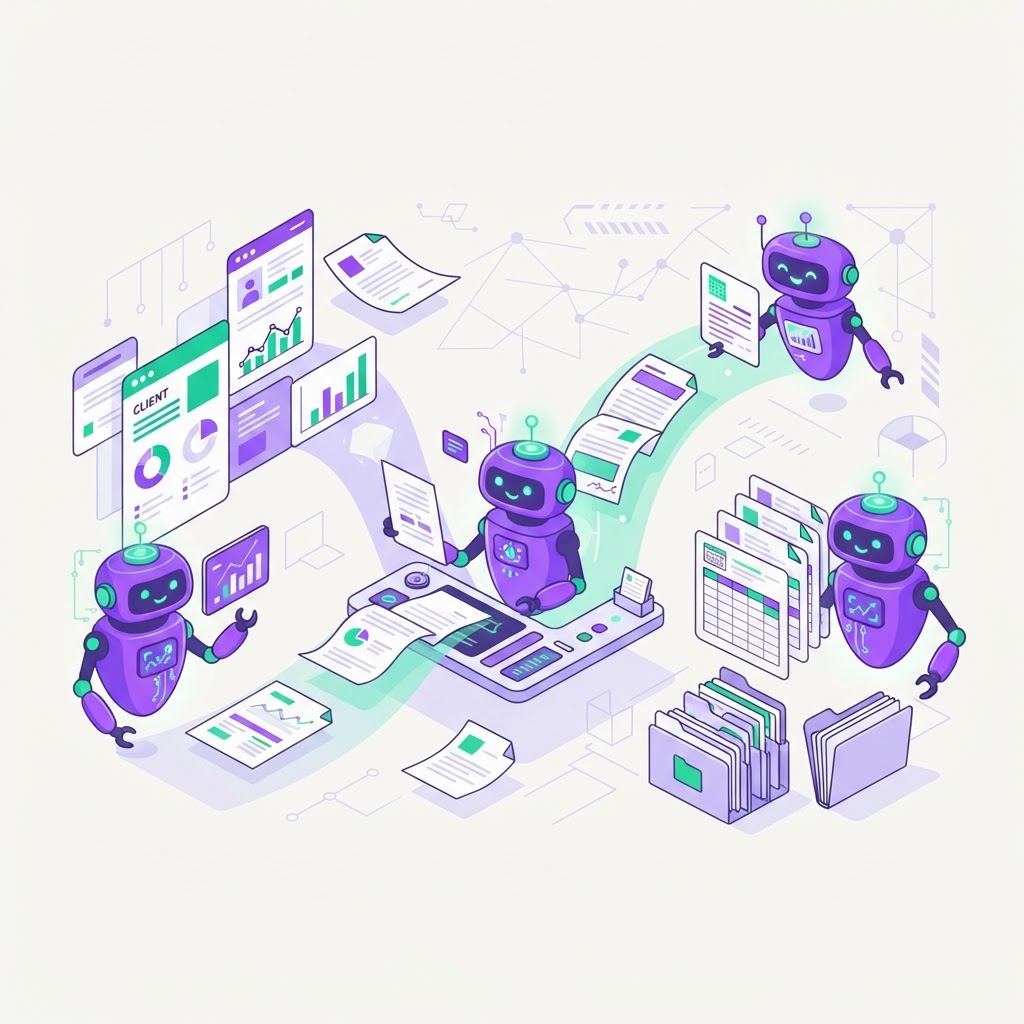
For Australian SME owners in accounting, consulting, and agency work, the term 'AI' often feels like a distraction. Most existing tools are either passive chatbots that answer questions or rigid automations that break the moment a process shifts. Professional services firms need something different: an agentic layer that doesn't just chat, but performs tasks across the systems you already use. Agentic AI platforms operate by connecting your existing ERP, CRM, and finance software via APIs to handle the repetitive 'glue work' that drains your billable capacity.
Solving the client onboarding bottleneck
Client onboarding is a classic example of low-value, high-effort work. Your senior consultants or lead accountants should not be spending hours chasing documents, verifying KYC data, or manually entering client details into three different platforms. An agentic platform sits across these systems, monitoring your inbox and your project management tools simultaneously. When a new client engages, the agent identifies the missing documents, sends branded requests, and waits for the files to land. Once the files arrive, the agent automatically sorts them into the correct project folder and updates your CRM status without human intervention.
This shift moves the accountant or consultant from being a document clerk to a reviewer. By the time a senior staff member opens the file, the administrative foundation is already solid. You aren't replacing your existing document management system; you are simply providing it with a workforce that never stops chasing.
First-draft reporting and advice packs
Consulting firms often struggle with the 'blank page' syndrome. Preparing a quarterly business review or a tax advice pack requires pulling data from various spreadsheets, accounting software, and historical client notes. Most firms rely on manual copy-pasting, which is prone to errors and burns through junior staff time.
An agentic platform connects directly to your source data to synthesize these reports. Instead of a human manually extracting metrics from Xero or a CRM, the agent pulls the necessary figures, formats them into your firm’s branded templates, and drafts the executive summary based on your specific house style. The human consultant then steps in for the 'review-in-the-loop' phase. This process guarantees that the AI acts as a sophisticated assistant that prepares the heavy lifting, allowing the expert to focus on the high-value strategic narrative.
Mastering time and billing hygiene
Time entry is the perennial enemy of profitability in professional services. When consultants forget to log hours for a week, they rarely remember the exact details, leading to 'guesstimated' billing that impacts cash flow and client trust. Agentic AI can solve this by acting as a silent observer across your digital environment.
By observing activity across email, project management tickets, and document edits, the agent can generate suggested time entries for the user to approve at the end of the day. This isn't about surveillance; it's about accuracy and billing hygiene. A system that recovers just 30 minutes of missed billable time per consultant per day adds up to significant revenue growth over a year. At a standard hourly rate, this ensures your utilisation metrics reflect your actual effort rather than your memory.
Inbox triage and stakeholder management
In agency settings, the inbox is often where productivity goes to die. Managing client expectations, answering common status queries, and coordinating meetings consumes hours of every day. An agentic platform does not just flag emails; it acts on them. It can distinguish between a routine status update and a high-priority request. For simple tasks, like rescheduling a meeting based on calendar availability or sending a templated update, the agent handles the task autonomously.
- Automatically cross-referencing incoming client queries with existing project timelines to provide instant status updates.
- Flagging urgent client requests that deviate from agreed project scope for human intervention.
- Extracting action items from email threads and pushing them directly into your project management board.
By automating this layer of communication, you ensure that clients receive instant acknowledgment while your team remains protected from the constant ping of minor interruptions. The result is a more responsive firm without the associated burnout.
The reality of implementation
Many SME owners fear that adopting new technology will result in months of downtime and expensive custom builds. However, the current state of agentic architecture is focused on integration rather than replacement. Because an agentic platform connects via APIs to your existing stack—be it Xero, HubSpot, or Jira—it can be deployed and operational within a matter of weeks. You keep your current systems, but you supercharge their utility by adding an intelligent coordinator on top.
- Identify your top three manual 'glue' processes that require human interaction between systems.
- Audit your team's time logs to see which repetitive admin tasks have the highest volume.
- Select a single pilot project, such as document chasing or draft reporting, to demonstrate ROI before scaling.
This approach avoids the 'all or nothing' trap of legacy software overhauls. It is about incremental, high-impact gains that pay for themselves through recovered billable time and improved staff utilisation. By placing the human in the loop for final approval, you maintain professional standards while offloading the administrative drag that hinders growth.
Where to start
To begin your journey with agentic AI, start by identifying the process that causes your team the most frustration during the 'start-of-engagement' phase, as this is typically the most rule-based and easiest to automate. Second, perform a brief audit of the gaps between your existing systems—where are your staff copy-pasting data manually? Third, schedule a consultation to map these specific pain points to an agentic workflow, focusing on a pilot project that can be launched in under thirty days.