Onboarding agents: getting new customers and staff productive in days
By Agentic Design
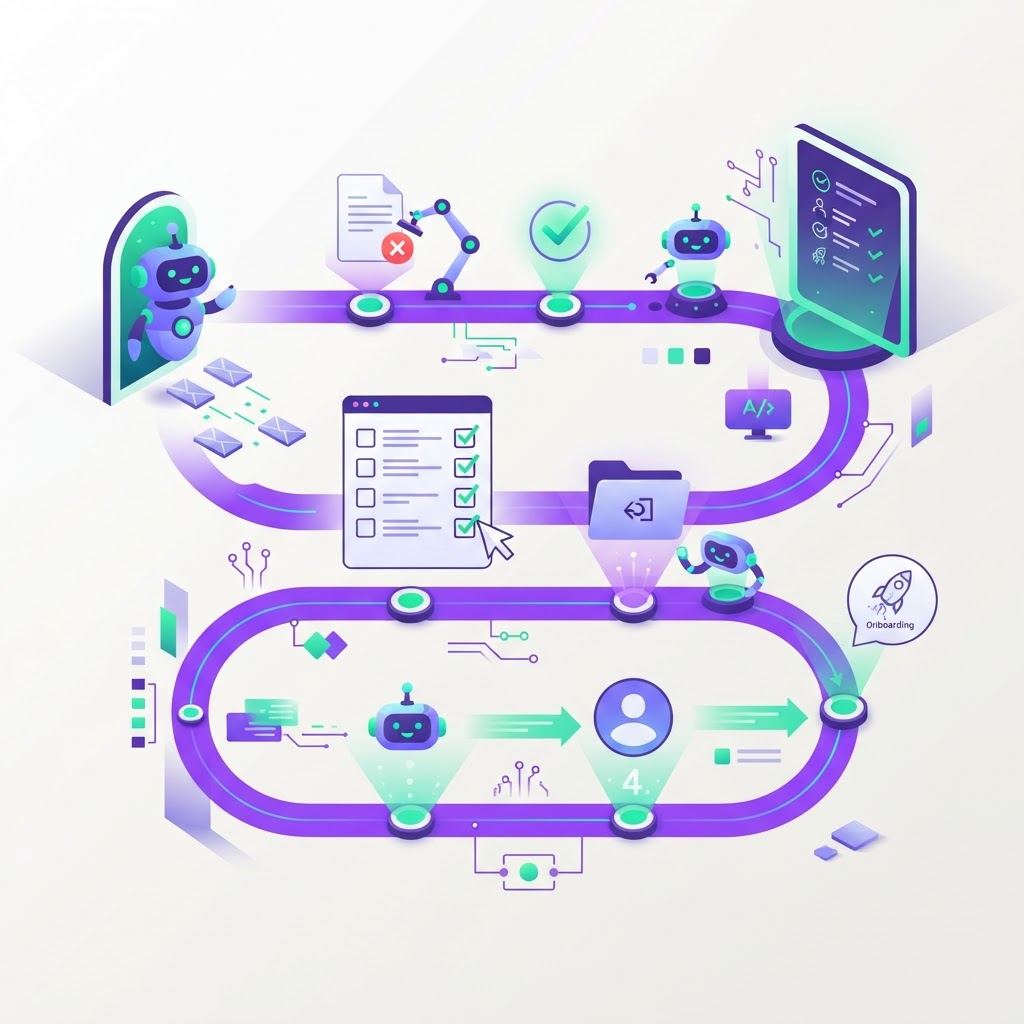
Onboarding is the first major impression a business makes, yet for most Australian SMEs, it remains a fragmented, manual nightmare. Whether you are bringing on a new staff member who needs laptop access, tax file numbers, and HR portal setups, or a new client requiring contract sign-offs and project management access, the process usually involves endless email chains and manual data entry across disconnected systems. When tasks are handled by humans following static spreadsheets, bottlenecks are inevitable, and crucial steps often slip through the cracks.
At Agentic Design, we see onboarding not as a personnel task, but as an agentic workflow. An agentic platform does not replace your CRM, ERP, or finance software; instead, it acts as an intelligent overlay that connects these disparate tools via APIs. It orchestrates the flow of information automatically, executing tasks across systems exactly as a diligent manager would, but without the delays caused by time zones, fatigue, or office hours. By delegating the repetitive administration to a platform, you ensure that new staff or customers are fully integrated into your environment within days, not weeks.
The anatomy of an automated onboarding workflow
For an SME, the cost of a slow onboarding process is tangible. If a new employee spends their first three days chasing IT access or waiting for payroll forms, you are paying for non-productive time. Similarly, if a client waits a week for their project to kick off because of internal account setup delays, their confidence in your business drops immediately. Automating this via an agentic layer means building a sequence of 'if-this-then-that' logic that spans your entire software stack.
Consider the typical employee onboarding sequence. When a candidate signs an offer letter in your HR portal, the agentic layer detects the trigger event. It immediately triggers a series of orchestrated actions across your internal architecture:
- The agent creates a user profile in your Microsoft 365 or Google Workspace environment.
- It provisions access to the specific folders and communication channels required for their role.
- It sends an automated, personalized welcome email that includes links to your internal wiki, health and safety documentation, and their first-week agenda.
- It logs the new hire's details in your payroll software to ensure no delay in their first pay cycle.
This is not just about convenience; it is about accuracy. By removing manual data entry from the equation, you eliminate typos in email addresses, missing access rights, or forgotten payroll entries. The platform manages the entire lifecycle of the onboarding task, "chasing" documents or signatures automatically by sending polite, timed reminders until the requirement is satisfied. You remain the manager, overseeing the process, while the agent performs the heavy lifting.
Integrating across your existing stack
Many Australian business owners are wary of "platform fatigue"—the idea that adopting new technology means rip-and-replace headaches. Our philosophy is that an agentic platform is the glue that holds your current investments together. It does not demand that you discard your Xero, HubSpot, or Trello setups; it simply talks to them. Because we build these platforms to interface with standard APIs, the implementation is typically completed within weeks, providing a massive return on investment by reclaiming thousands of hours of administrative time annually.
For customer onboarding, the agentic workflow is equally transformative. Imagine a scenario where a new client signs a contract. The agent immediately creates the client folder in your file storage, triggers an invoice in your accounting package, creates a new project board in your management software, and sends an automated link to the client for their first discovery meeting. The client feels prioritized and professional, while your team spends zero time doing the administrative "busy work" that currently consumes their Monday mornings.
- Standardize the data inputs so that every client or employee entry follows the same verified format.
- Set conditional logic to handle exceptions, such as different access levels based on geography or department.
- Implement automated audit logs that show exactly who did what, and when, for total transparency.
Measuring the impact on productivity
When you quantify the time saved, the business case for an agentic layer becomes undeniable. If your manual onboarding process takes five hours per person, and you hire ten staff and five clients per year, you are losing 75 hours annually. More importantly, you are losing the morale of high-performing employees who are stuck doing data entry instead of revenue-generating work.
By automating this, you reduce the time from 'contract signed' to 'fully operational' to mere hours. A new hire can walk into the office on their first day, log in with credentials that are already active, and find their workspace fully provisioned with the tools they need. This shift in operational maturity signals to your team and your customers that your business is organized, efficient, and forward-thinking. It allows you to scale your team or your client base without a linear increase in administrative headcount.
Where to start
- Map your current "manual" onboarding process step-by-step on a whiteboard, noting every time someone switches between two different software applications.
- Identify the top three bottlenecks—such as credential provisioning or contract signature chasing—that consistently cause delays in your current workflow.
- Contact our team to perform a two-day technical audit to determine which of your existing APIs are ready for agentic integration, allowing you to start automating your highest-impact task immediately.