Not-for-profits: agentic support for grants, volunteers and reporting
By Agentic Design
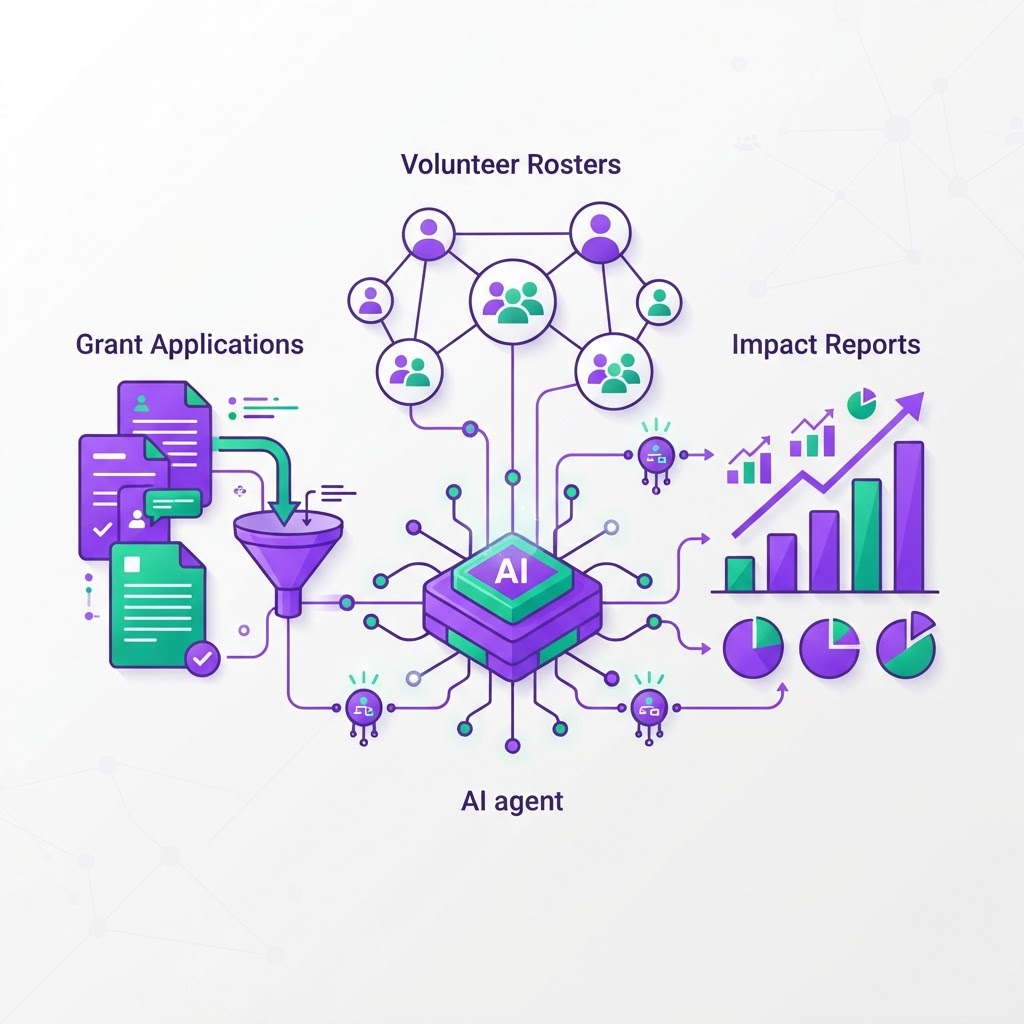
For many Australian not-for-profits (NFPs), the challenge is not a lack of mission or ambition, but a lack of administrative bandwidth. Small community organisations are often held back by the sheer volume of manual overhead required to sustain their operations, from the endless cycle of grant applications to the coordination of local volunteer rosters. Agentic design offers a pragmatic path forward for these groups by creating an intelligent layer that sits across your existing tools, allowing your disparate systems to talk to each other and act autonomously. Unlike software that forces you to migrate your data into a new, expensive silo, an agentic layer connects to your current CRM, accounting software, and spreadsheets via APIs to perform actual work on your behalf. This is not about replacing your finance or member management platforms; it is about providing the connective tissue that turns passive data into active results. By deploying agentic workflows, an organisation can reduce the time spent on routine administrative tasks by up to 60%, allowing staff and volunteers to refocus on the community members they serve. In an environment where every dollar is scrutinised, the ability to automate low-value, high-effort work is the ultimate force multiplier for lean operations. ## Grant Discovery and Strategic Drafting The grant lifecycle is often a bottleneck for small organisations, consuming hundreds of hours in research and writing for uncertain returns. An agentic platform can monitor government and private foundation grant portals, cross-referencing new opportunities against your organisation's core mission and historical project outcomes. When a suitable grant appears, the agent does not just send a notification; it drafts a high-quality initial application. It pulls relevant financial data from your accounting software and impact metrics from your CRM to create a draft that is already 80% complete. This allows your team to move from the arduous task of drafting to the high-value task of final review and strategic refinement. By removing the "blank page" anxiety and the repetitive retrieval of organisational data, you can realistically double the volume of applications submitted each year without increasing your headcount. ## Simplifying Acquittal Reporting If grant writing is the beginning of the burden, acquittal reporting is the end of it, and it is frequently where NFP managers feel the most strain. Every grant comes with strict reporting requirements that necessitate sifting through months of invoices, program logs, and attendee registers. An agentic layer automates this by continuously tagging and categorising project-related expenditures and outcomes as they happen in your ERP or spreadsheets. Instead of spending two weeks every quarter manually assembling a report, your agent generates an evidence-backed acquittal report in minutes. It can highlight potential compliance risks, such as an upcoming budget overrun on a specific grant line item, long before the report is due. This shifts the process from a reactive, stressful scramble into a continuous, audit-ready state, ensuring that your organisation remains in good standing with donors and government bodies. ## Volunteer Coordination and Donor Engagement Managing a network of volunteers is inherently complex, often involving a fragmented mix of emails, SMS, and manual rostering. Agentic systems excel at this because they can act as an intelligent intermediary between your volunteer database and your scheduling software. If a volunteer cancels a shift, the agent automatically triggers a re-allocation process, identifying qualified replacements, sending out personalised availability requests, and updating the roster once a shift is claimed. This removes the need for a staff member to spend hours on the phone chasing replacements. Similarly, donor communications can be scaled through the same principle of intelligent automation. * Automated welcome journeys for new recurring donors based on their specific area of interest. * Proactive "impact" emails that share specific project updates tailored to the donor's previous contribution history. * Automated thank-you notes that include relevant impact metrics, ensuring donors feel a direct connection to the organisation's current progress. By making these interactions consistent and timely, you increase donor retention rates and reduce the administrative effort required to maintain meaningful relationships. ## Low Budget, High Leverage Implementation One of the most common misconceptions is that agentic AI requires a complete overhaul of an organisation's digital infrastructure. On the contrary, the power of an agentic layer is that it works within your existing ecosystem. We connect to the tools you already use, meaning there is no need for costly data migrations or a steep learning curve for your team. A typical integration project can be delivered in just a few weeks because it focuses on solving specific operational pain points rather than attempting a total digital transformation. By treating your existing systems—Xero, Salesforce, HubSpot, or even Excel—as an API-connected network, we build a bridge that performs tasks, moves data, and triggers actions. This modular approach is designed for the NFP budget. It allows you to automate a single, high-impact workflow first, see the immediate efficiency gains, and then incrementally layer on more agents as your needs evolve. This is not about vanity technology; it is about building sustainable, long-term operational resilience that scales with your mission. ## Where to start 1. Audit your most time-consuming recurring task, such as a monthly report or volunteer scheduling, and identify which systems currently hold the data for that process. 2. Define the specific "hand-off" point where your staff currently performs a manual action—like copying data from a spreadsheet into a document—as this is the primary target for your first agent. 3. Reach out to our team for a short discovery session to map your current software stack and confirm which API integrations are available to start your first automation project immediately.