Membership associations: agents for renewals, events and member support
By Agentic Design
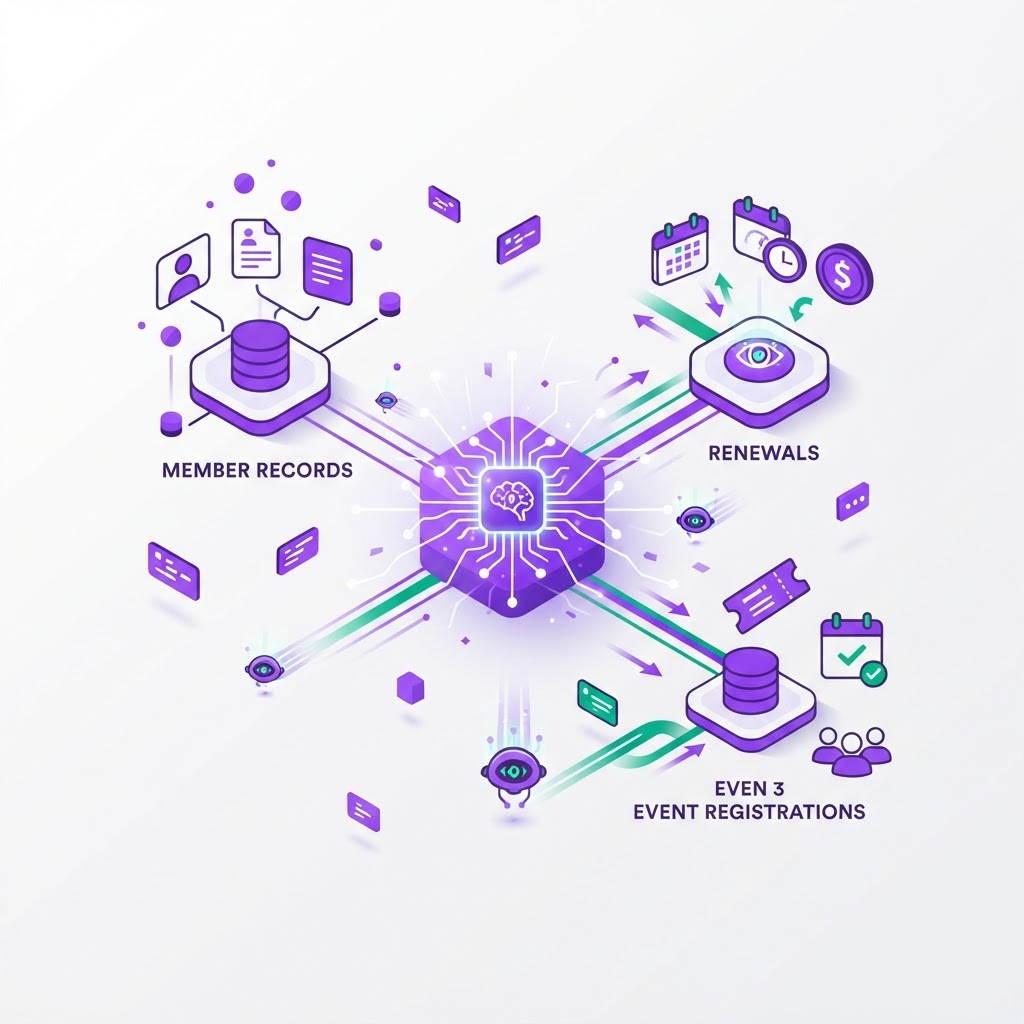
For many Australian membership associations, the administrative burden of running an organisation is starting to outweigh the value provided to members. Whether you are a professional body, a trade union, or a community association, your team is likely spending hours on manual tasks that provide little strategic value. Small and medium-sized enterprises often feel caught between expensive, rigid software upgrades and the limitations of legacy spreadsheets. The modern solution is not a wholesale system migration, but an agentic layer that sits across your existing tech stack to handle the repetitive, high-volume tasks that keep your organisation running.
The reality of the integration layer
Many association managers fear that adopting AI means discarding years of data trapped in existing CRMs, accounting platforms like Xero, or scattered event management spreadsheets. Agentic design operates on a different principle: it acts as a connective tissue rather than a replacement. By using APIs to talk to your current systems, an agentic platform reads and writes data exactly as a human staff member would, but at a significantly higher speed and with perfect consistency. This means your member data remains where it is, but becomes actionable through automated workflows.
When we talk about an agentic layer, we are describing a system that understands intent and executes multi-step processes. For an Australian SME, this offers a practical way to scale operations without increasing headcount. You maintain your 'source of truth' in your existing database, while the agentic layer monitors for triggers—such as an approaching membership expiry or a new event registration—and takes immediate, appropriate action.
Automating the renewal cycle
Renewal periods are often the most stressful time for membership bodies. Chasing unpaid dues is a repetitive task that consumes significant manual effort, often involving multiple emails and manual reconciliation of bank statements. An agentic platform can monitor your membership database and cross-reference it with your financial system in real-time.
Consider an association with 2,000 members. If 15% are late on their dues, that is 300 individual follow-ups. An agentic system can identify these specific members, draft personalised reminders that reference their specific membership tier, and trigger those messages via email or SMS. If a member pays, the system detects the transaction in your bank feed, updates the CRM record, and issues a tax invoice automatically.
- Automated invoice generation based on membership anniversary dates.
- Dynamic email triggers that escalate from gentle reminders to formal notifications.
- Instant synchronization between payment gateways and CRM status updates.
Transforming event management
Events are the lifeblood of membership engagement, but the logistics of registration, dietary requirements, and ticketing often result in administrative bottlenecks. A typical event might involve a member booking a ticket, the staff manually entering details into a spreadsheet, and then sending out follow-up confirmation emails. If a dietary request comes in late, it often gets lost in the inbox shuffle.
An agentic platform can manage the entire lifecycle of an event registration. It can receive the inquiry, check the member’s status in the CRM, verify that they are eligible for member-discounted pricing, and issue the ticket confirmation instantly. If a member changes their details or requests a dietary adjustment, the agent updates the attendee list and notifies the venue or caterer directly via email without human intervention.
Member enquiries and CPD tracking
Providing timely support is critical, but high-volume, low-complexity enquiries can easily overwhelm a small team. When a member emails to ask about their Continuing Professional Development (CPD) status or to reset their portal access, they expect a response within minutes, not days. An agentic agent can scan incoming enquiries, pull the relevant data from your existing systems, and provide a comprehensive, accurate response.
For CPD tracking specifically, the agent acts as an automated auditor. It can monitor the logs of completed training sessions, calculate the total credit hours accumulated against a member’s specific certification requirements, and send proactive notifications if they are falling behind. This moves your organisation from a reactive stance—where members realise they are short of credits at the last minute—to a proactive, supportive posture.
- Automated collation of CPD hours across multiple training providers.
- Predictive alerts sent to members when they are 20% away from their annual requirement.
- Self-service verification processes that allow members to download their own compliance certificates.
Practical implementation for SMEs
The biggest barrier for Australian associations is often the perception that AI implementation takes months or even years. Because an agentic layer connects to your existing APIs, the implementation time is typically measured in weeks, not months. The process begins by identifying the 'highest friction' task—usually renewals or event management—and building the agentic workflow to handle just that specific function.
By keeping the platform standalone, you retain complete control over your data. If you decide to move your CRM to a new provider in the future, the agentic layer can be re-routed to the new API, ensuring continuity of service without needing to rebuild your entire automation suite from scratch. This modular approach is essential for long-term sustainability.
Where to start
- Audit your current manual tasks: Create a list of the top three processes that consume the most staff time each week, such as chasing invoices or event registrations.
- Verify your API accessibility: Check that your current CRM and accounting software offer API access, which allows an agent to read and write data to those systems.
- Run a pilot project: Choose one low-risk, high-volume process to automate for a period of four weeks to measure the time saved and the accuracy of the automated results.