Measuring the return: how to build the business case for an agentic platform
By Agentic Design
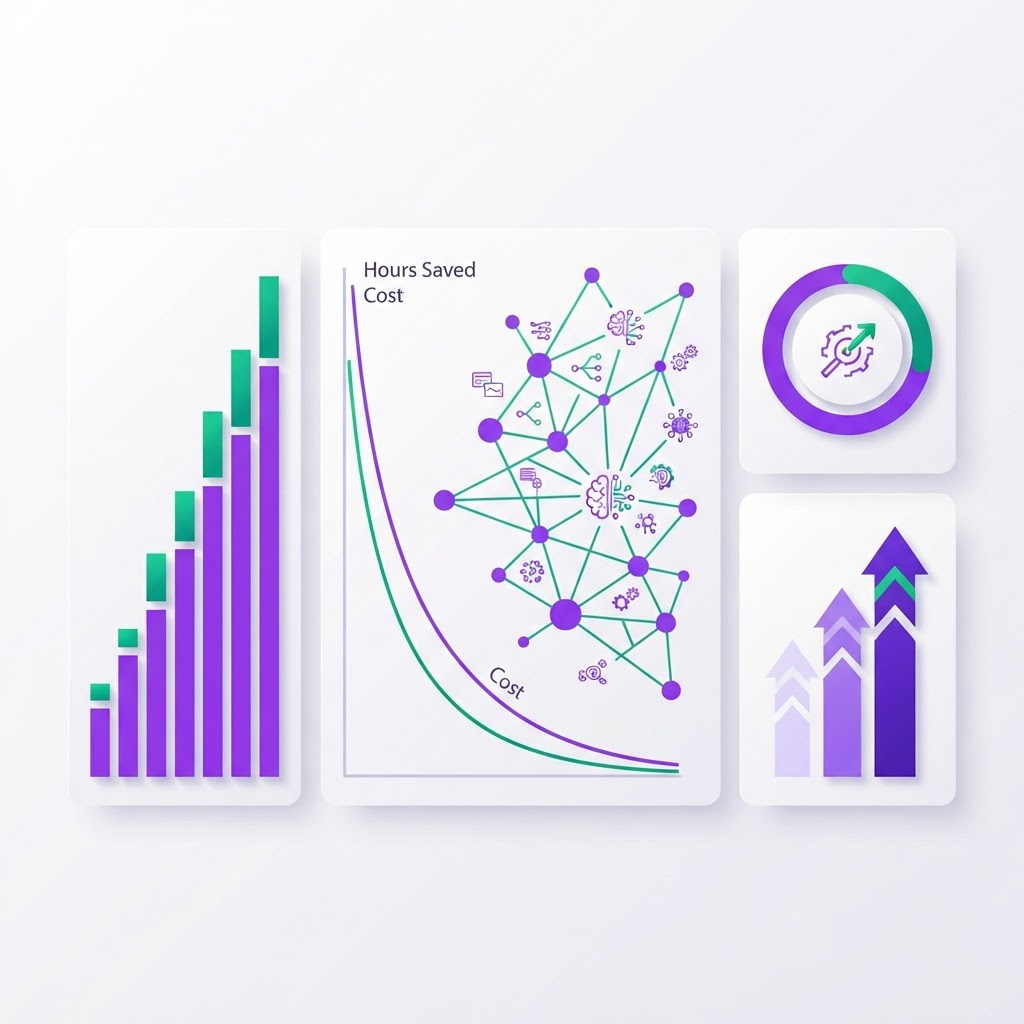
For Australian SME owners, the promise of artificial intelligence often feels like a choice between expensive, unproven experiments or total system replacement. Neither path makes sense for a business that already relies on a functioning stack of accounting software, CRM platforms, and inventory systems. The reality is that your existing infrastructure is likely sufficient, but the labour-intensive work of moving data between those systems is where your profit margin leaks away. An agentic platform acts as a connective layer, sitting on top of your existing software to automate complex tasks without replacing your primary tools.
Define your operational baseline
The biggest mistake businesses make when evaluating AI is failing to establish a concrete baseline. Before you talk to vendors or look at fancy dashboards, you must identify a specific, repetitive, high-volume process that currently ties up your staff. If you cannot measure the process today, you cannot measure the efficiency gains tomorrow. Start by documenting exactly how long a task takes from start to finish, including the time spent switching between windows or manual data entry.
- Identify a process that requires data to move from System A to System B.
- Count the exact number of transactions or occurrences per week.
- Calculate the hourly rate of the employee currently performing this work.
Do not include 'learning time' or hypothetical productivity gains in your initial audit. Focus strictly on the direct labour cost associated with the transaction. If it takes your office manager twenty minutes to process a customer order by copying details from a web form into your ERP, and you receive fifty orders a week, your baseline cost is fixed, measurable, and easily verified.
The cost of the agentic layer
When we deploy an agentic platform at Agentic Design, we charge for the orchestration of the workflow rather than the underlying software licenses. Your cost structure consists of three main components: the initial development of the agentic logic, the ongoing API connectivity, and the monthly platform subscription. Because this layer sits across your existing tools, you avoid the massive capital expenditure of a digital transformation project.
Building a business case requires that the total cost of this implementation is recovered within a predictable timeframe, usually six to twelve months. If the implementation takes weeks rather than months, you significantly reduce the risk and ensure the business case stays lean. You are essentially paying for the 'glue' that enables your existing software to talk to one another autonomously.
A worked example: The procurement agent
Consider a wholesale business managing inventory replenishment across two systems. The manager currently spends 15 hours a week reviewing low-stock alerts in their inventory system and then manually generating purchase orders in their accounting package. This is a task that never changes, involves strictly defined logic, and is prone to human error.
If that manager earns $40 per hour, the annual cost of this process is roughly $31,200 in direct labour. Now, introduce an agentic platform. The cost to design, deploy, and maintain an agent that reads the inventory report and pushes the purchase order to the accounting API might be $15,000 in year one, with an ongoing operational cost of $5,000. In the first year, your net savings reach $11,200. In year two, your savings jump to $26,200.
Scaling the decision
Once the first agent proves itself in a single department, you face the decision to scale. The beauty of an agentic platform is its modularity; you do not need to overhaul your entire business to see returns. You can treat each automated workflow as an independent profit centre. If an agent manages to save five hours a week, and the cost to run that agent is lower than the value of those five hours, the logic to scale becomes undeniable.
- Focus on high-frequency, low-variance tasks first.
- Ensure the agent logs its actions clearly for audit purposes.
- Reinvest the saved hours into customer-facing growth activities.
Do not attempt to automate your most complex, subjective decision-making processes immediately. Start where the data is structured and the outcome is binary. As your team grows more comfortable with the agentic layer, you can expand the scope into more nuanced areas like customer support triage or automated invoicing.
Measuring the impact of speed
Beyond simple cost-saving, consider the 'time-to-action' metric. In competitive Australian markets, speed often dictates win rates. If your agentic layer reduces the turnaround time for a quote or an inventory update from three hours to three seconds, you are not just saving money; you are increasing your service capacity. This creates a compounding effect where your SME can handle higher volumes without the proportional need to hire more administrative staff. That is where the true strategic return on investment is found, shifting your focus from maintenance to genuine market expansion.
Where to start
- Select one repetitive, manual task that involves at least two pieces of software and time it for one full week.
- Calculate the annualised labour cost of that task, including superannuation and overheads, to establish a hard baseline.
- Identify the specific API endpoints or CSV export functions your existing software provides to see if the data is accessible for an agent.