Inventory management and agents: fewer stockouts, less dead stock
By Agentic Design
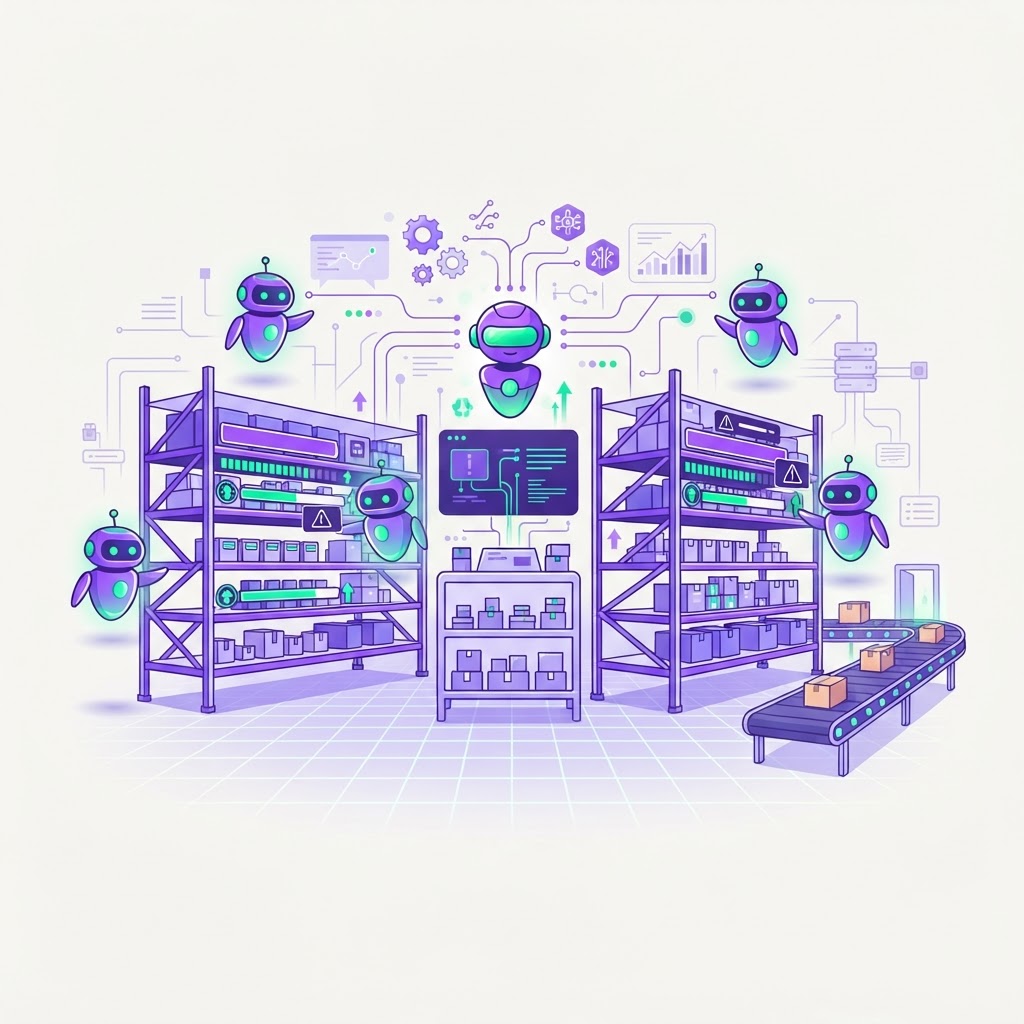
For many Australian small-to-medium enterprises, inventory management often feels like a high-stakes balancing act between two extremes. On one side, you have the persistent threat of stockouts costing you sales; on the other, the silent profit-killer of dead stock tying up your cash. Most businesses rely on a patchwork of ERP software, spreadsheets, and gut instinct to manage this tension. When these systems are siloed, the manual effort required to keep them aligned becomes a full-time job that rarely yields the precision you need.
Agentic AI offers a different approach. Rather than ripping out your current stack—whether that is Xero, MYOB, NetSuite, or a collection of disconnected spreadsheets—an agentic layer functions as an intelligent interface that connects these systems via API. It acts as a digital operator that observes your data, executes tasks, and alerts you to anomalies before they become expensive problems. This is not about replacing your tools; it is about making them talk to each other and act on the insights they hold.
The reality of trapped working capital
Every dollar sitting on a shelf as unsold inventory is a dollar that cannot be used for marketing, staff, or expansion. In the Australian market, where supply chain volatility remains a constant, businesses often over-order to compensate for lead-time uncertainty. This 'safety stock' approach is a common response to inefficient forecasting, but it is fundamentally a drain on your working capital.
An agentic layer changes the equation by calculating reorder points based on live demand signals rather than historical averages alone. Instead of waiting for a manual stock check, the agent tracks velocity in real-time across your sales channels. By aligning replenishment schedules with actual consumer movement, you can reduce the amount of capital locked in warehouse space by 15% to 20% within the first few months of operation.
Moving beyond simple threshold alerts
Most inventory systems operate on basic 'min/max' rules. These are crude tools; if your sales velocity changes due to seasonality or a marketing campaign, these thresholds become obsolete immediately. An agentic platform treats these thresholds as dynamic, constantly adjusting them based on current market signals.
- Automatic reorder recommendations that adjust based on supplier lead-time changes.
- Proactive supplier follow-ups when tracking indicates a delay before the stock actually runs out.
- Slow-mover flagging that identifies products losing momentum well before they reach their expiry or seasonal obsolescence.
- Intelligent cycle count prompts that focus on high-variance items rather than wasting staff time on counting stable inventory.
By handling the repetitive legwork of checking supplier portals and sending status emails, your staff can focus on high-value tasks like improving supplier relationships or refining product sourcing. The agent doesn't need to sleep or take breaks; it monitors the inventory environment 24/7, ensuring that your data remains the source of truth.
Bridging the gap between software silos
One of the greatest challenges for SMEs is that the finance team looks at spreadsheets, the warehouse team looks at the ERP, and the sales team looks at the CRM. These teams are rarely looking at the same version of reality. An agentic layer sits across these silos, pulling data from each to form a coherent, business-wide view.
For example, when a salesperson closes a large B2B deal, the agent immediately checks current stock levels against the promised delivery date. If the inventory isn't there, it drafts a purchase order or notifies the purchasing manager instantly. This removes the latency between a sales event and an operational response. You avoid the embarrassment of selling stock you don't have, and you maintain a lean inventory profile that doesn't waste precious space.
Implementation without the disruption
Many operators worry that 'AI' implies a six-month, six-figure implementation project. Because an agentic layer connects to the systems you already use, it is designed for rapid deployment. We can integrate with your existing APIs in a matter of weeks, allowing the agent to begin auditing your inventory patterns immediately. You don't need to migrate data or change your workflows; you simply grant the agent the permissions to act as an assistant to your existing team.
This is a practical evolution of your infrastructure. By layering agency over your existing software, you gain a system that can suggest, communicate, and correct in real-time. It provides the visibility required to make informed financial decisions, turning your inventory from a liability into a highly responsive asset.
Where to start
-
Audit your current system latency: Identify how long it currently takes for a stock movement or sales change to reflect in your procurement process and target that gap first.
-
Consolidate your data access: Ensure you have API access or export capabilities for your primary platforms, such as your ERP and your sales channels, as this is the raw material the agent will use.
-
Define your high-impact categories: Choose 10% of your inventory items that have the highest margin or highest volatility and pilot the agentic monitoring on these specific SKUs before rolling it out across your entire catalogue.