Insurance brokers and underwriters: agentic intake, quoting and renewals
By Agentic Design
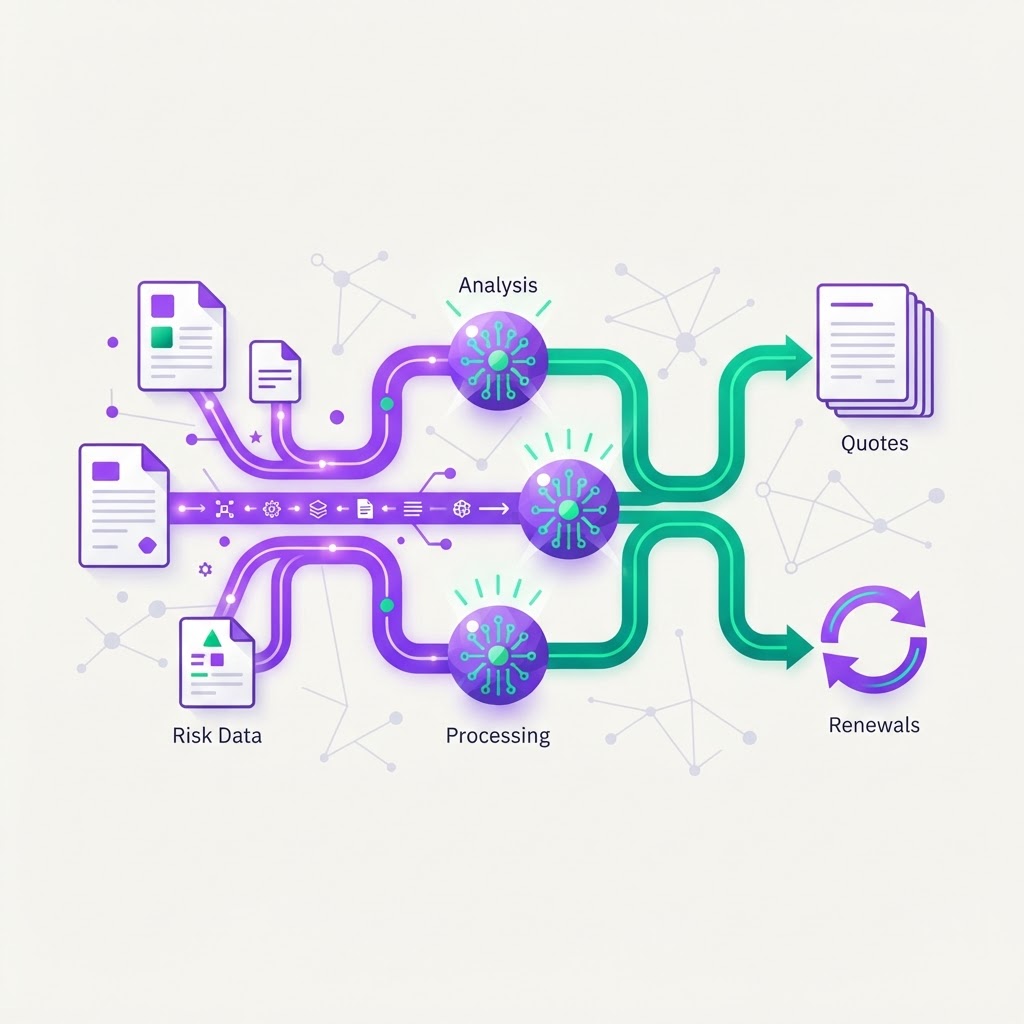
For Australian insurance brokers and small underwriters, the daily grind often involves moving data between disparate systems. You might be keying data from a PDF proposal into a spreadsheet, then copy-pasting that same information into your CRM or underwriting platform. This manual "swivel-chair" work is not only slow, but it also introduces significant operational risk and human error. At Agentic Design, we see a better path forward that does not involve ripping out your current tech stack or forcing your staff to learn a new, complex enterprise software suite.
The agentic layer approach
Rather than replacing your existing CRM, finance, or policy management systems, an agentic layer sits above them. Think of it as a digital teammate that has the permissions to access your systems via APIs to execute tasks autonomously. It reads incoming emails, extracts relevant risk data, validates that information against your compliance requirements, and updates your records without you needing to press a button. This is not just automation; it is the deployment of a specialized worker that understands the context of a commercial insurance submission.
Transforming submission intake and quoting
Consider the typical submission intake process. Your inbox is flooded with diverse documents: ACORD forms, broker-specific applications, and unstructured email attachments. An agentic platform can monitor these mailboxes, categorize the risk, and extract the required data points instantly. If a document is missing a critical field, the agent flags it immediately rather than waiting for a human to notice the omission three days later.
- Automated extraction of policy limits, turnover figures, and previous claim history from unstructured PDFs.
- Direct API integration to populate your primary underwriting or brokerage system with clean data.
- Immediate cross-referencing against internal risk appetite documentation to triage leads.
Once the data is prepped, the agent can generate a quote comparison document or draft an indicative offer. By automating these first few hours of processing, you shift your staff’s focus from data entry to high-value decision-making and relationship management with your clients.
Managing renewals with precision
Renewal cycles are often where brokers and underwriters lose the most time due to inefficient follow-ups. A well-designed agent monitors renewal dates and triggers proactive communication cycles tailored to each client profile. It can pull the updated inventory figures or financial reports from your finance software, reconcile them against the previous year’s policy, and draft a tailored renewal offer.
This process ensures that your renewal pipeline never stalls. If a client has not responded to an email, the agent can escalate the reminder or flag the account for personal intervention. In a portfolio of 500 policies, this ensures that every single renewal receives timely attention, reducing the risk of lapses or coverage gaps that create liability issues.
Claims status and the audit trail
Transparency is a core requirement in the Australian insurance market, particularly under current regulatory standards. When clients inquire about the status of a claim, the information is often buried in a secondary system or a chain of emails. An agentic layer can aggregate claim status updates from disparate sources and provide a single, verified view for the broker.
Because every action taken by the agent is logged through API calls, you automatically generate an immutable audit trail. This means that when an external auditor asks why a policy was bound or how a claim adjustment was calculated, you can produce a time-stamped log showing the logic applied. This level of compliance reporting is far more robust than relying on manually updated spreadsheets that are prone to modification.
Practical implementation for SMEs
Many SME leaders fear that implementing AI will take months of planning and significant capital investment. However, an agentic layer is designed for modular deployment, meaning you can start by automating one specific bottleneck. Whether that is simple data extraction from email attachments or the reconciliation of renewal spreadsheets, the platform can be live in weeks rather than months.
- Identify the process that consumes the most "swivel-chair" time, such as manual data entry into your CRM.
- Map the data flow from current email attachments into your existing policy management software.
- Test the agentic layer on a single product line to measure speed and accuracy improvements.
By focusing on these specific, measurable outcomes, you build confidence in the technology while maintaining full control over your operations. You keep your existing systems, but you grant them the ability to work together efficiently. This is how modern, competitive brokerages and underwriting agencies are scaling without increasing their headcount.
Where to start
To begin your journey with agentic AI, follow these three steps to ensure success. First, audit your current data-heavy workflows to identify exactly which manual tasks contribute to the highest backlog. Second, consult with your existing software providers to confirm API availability, which is the gateway for an agent to connect your systems. Finally, choose one specific, high-frequency process—such as renewal chasing—to pilot the agentic platform, ensuring you can measure the reduction in manual effort within the first thirty days.