How an agentic platform works across your existing systems
By Agentic Design
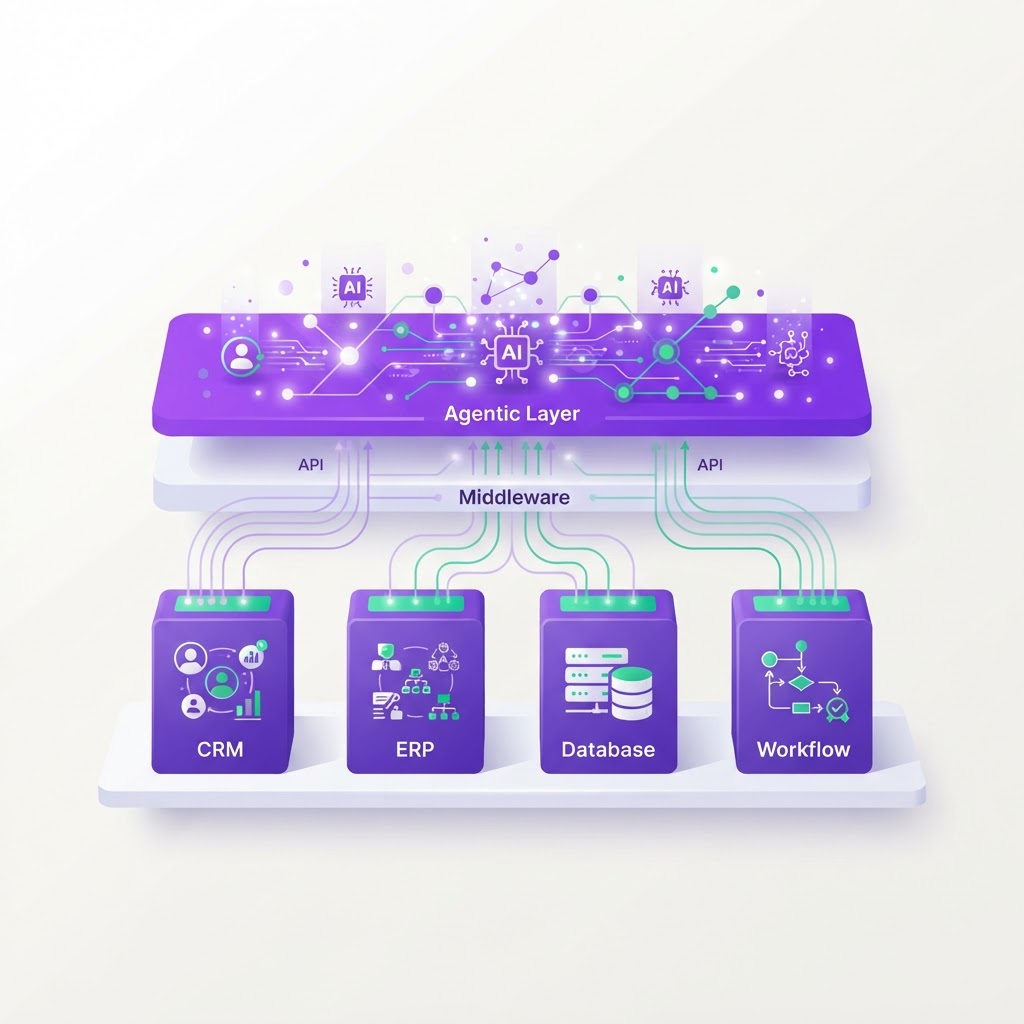
For many Australian business owners, the dream of automation feels perpetually out of reach because it seems to require a complete 'rip and replace' of your software stack. You have spent years fine-tuning your CRM, getting your inventory system just right, and training staff on your finance tools. The idea of migrating all that data into a new, all-encompassing suite is often enough to keep you stuck in manual processes. An agentic platform provides a different path, functioning as a bridge between your existing systems rather than a replacement for them.
The architecture of an agentic layer
Think of an agentic platform not as a new database, but as a layer of intelligence that sits across your existing infrastructure. It treats your current software—whether that is Xero, HubSpot, or a legacy ERP—as a set of tools it can use. The platform connects to these systems using their native APIs, meaning it can read data, perform actions, and move information between them exactly as a staff member would, but with greater speed and consistency.
Crucially, the agentic platform maintains its own workspace and memory. When it performs a task, it doesn't just execute a command; it evaluates the context, checks its instructions, and retains a record of what it has done. It creates a secondary, 'intelligent' layer that manages the workflow while your core systems continue to act as the 'source of truth' for your financial and operational data. This architecture ensures that your data remains where you need it to be, preserving your existing reporting and compliance workflows.
Why you don't need to migrate
Migration projects are notorious for time blowouts and data loss. Because our agentic approach leaves your core systems untouched, you avoid the risks associated with moving databases or changing user interfaces. The platform works by orchestrating operations across the boundaries of your current software. For example, if you receive a new client inquiry in your email, the agentic layer can trigger an action to verify the contact in your CRM, check inventory levels in your stock system, and draft a quote—all without you ever moving a single file.
- Your existing software remains the primary interface for your employees.
- Data integrity is maintained because you aren't moving sensitive information to a third-party server.
- Connectivity is established through standard API protocols, meaning setup is measured in weeks, not years.
By adding an agentic layer, you are effectively bolting on a high-performing digital assistant that understands how to use your existing tools. If you change your CRM in the future, you simply swap the connection in the agentic layer. The core logic of how your business processes work remains intact, making your technology stack much more resilient to change.
A day in the life of an automated workflow
Imagine you run a wholesale distribution business. A customer sends an urgent order request via email at 4:00 PM. In a traditional setup, this email might sit in an inbox until the next morning. With an agentic platform, the agent intercepts the email, identifies it as an order, and immediately pulls the client's current credit status from your finance software. If the credit is good, it checks the stock level in your inventory system.
If the items are available, it creates the sales order and emails a confirmation back to the customer. If the items are low, it flags a task for a procurement manager. This entire sequence happens in minutes, without a human logging into a single system. The agentic layer acts as the glue that binds your siloed systems together, turning passive data into active work. You stop paying for systems that just hold data and start paying for systems that actively contribute to the bottom line.
What changes on day one
On day one of implementing an agentic platform, very little changes in how your team interacts with their screens. Your staff still log into their familiar applications; they don't have to learn a new interface. The most significant shift is that they stop performing repetitive, low-value tasks like manual data entry or system reconciliation. This allows your team to focus on high-value activities, such as managing relationships, resolving complex problems, and identifying new growth opportunities.
- Productivity increases because bottlenecks are cleared in real-time.
- Error rates in data entry plummet as the agent handles the heavy lifting.
- Operational costs remain predictable because the platform scales with your volume, not your headcount.
You will notice that your key business metrics begin to improve. Since the agentic layer operates 24/7, response times to customers drop significantly. In an Australian market where service speed is often the key differentiator, this provides a major competitive advantage. You are essentially extending your operational capacity without the overheads associated with recruitment, training, and onboarding new administrative staff.
Where to start
Start by auditing your most manual, time-consuming cross-system workflows. Identify processes where data is copied from one system to another manually, as these are the lowest-hanging fruit for agentic automation. Once identified, ensure your current systems have functional API access, which is standard for almost all modern SaaS platforms. Finally, reach out for a consultation to define the specific scope of an agentic layer pilot, focusing on a single, high-impact workflow that can be delivered in a three-week window.