Customer support agents that escalate well
By Agentic Design
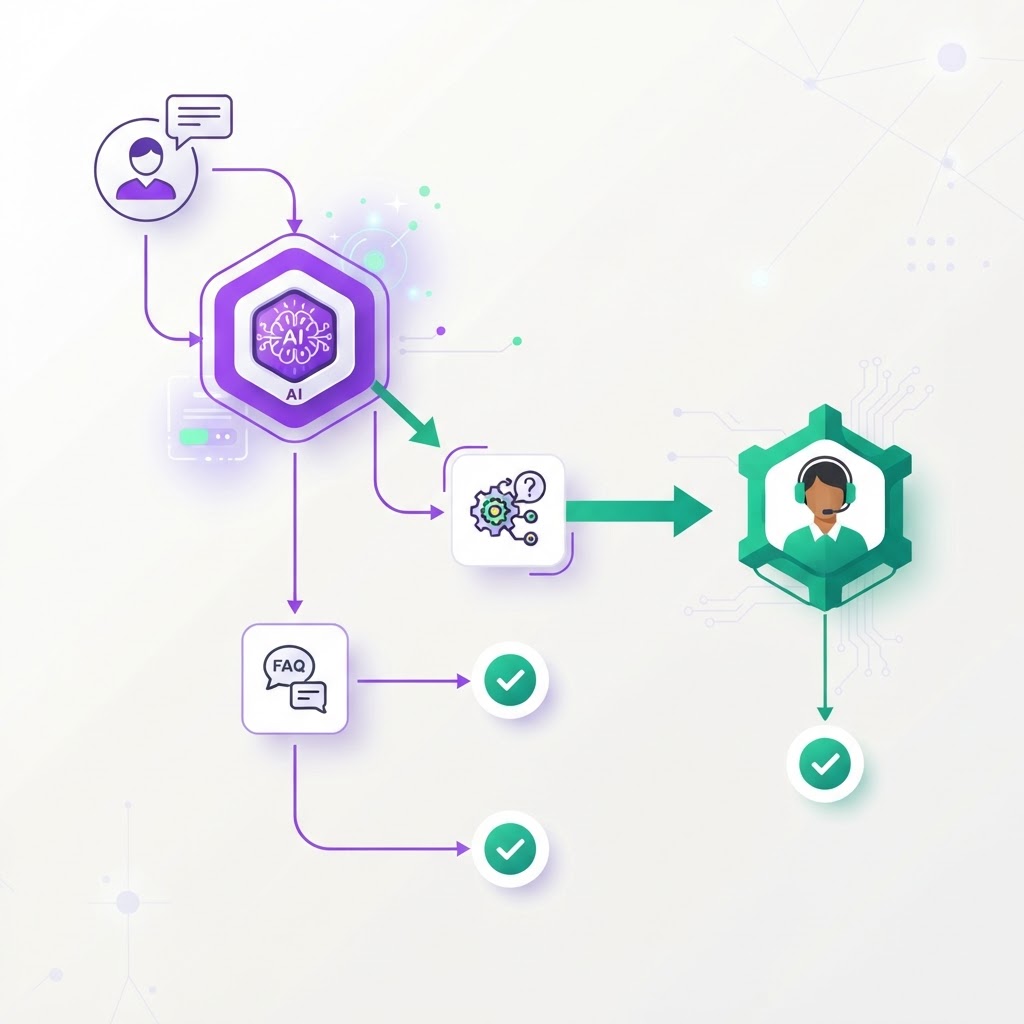
For most Australian SMEs, the promise of AI in customer support has been framed as a race to deflection. The goal is often defined simply: reduce the number of tickets hitting human inboxes. However, this is a flawed metric. If you deflect a query that requires empathy, nuance, or a complex resolution, you are not saving money; you are eroding your brand. An effective agentic AI platform acts as a bridge, not a wall, working across your CRM, ERP, and inventory systems to solve what can be solved and escalating the rest with surgical precision.
The scope of agentic competence
An agentic AI layer is fundamentally different from a standard chatbot. While a chatbot follows a rigid decision tree, an agentic system is designed to perform tasks. It can query your inventory, check order status in your ERP, or process a standard refund based on your business rules. The golden rule for defining what an agent should handle is simple: if the data is objective, the logic is binary, and the outcome is repeatable, let the agent handle it.
Examples of high-utility tasks for agents include:
- Checking the live tracking status of a parcel directly from your logistics provider API.
- Updating customer contact details across your CRM and accounting software.
- Processing routine returns that meet your published policy criteria.
- Providing standard information about product specifications or store hours.
When you move beyond these objective tasks into subjective territory—such as a complaint about service or a request for a custom discount—the agent must recognise the boundary. It should not attempt to 'fake' human empathy or guess policy exceptions.
Designing the perfect hand-off
When the agent reaches the limit of its capabilities, the hand-off to a human agent must be seamless. A poor escalation feels like a 'dead end' to the customer. A good escalation feels like an assistant handing a file to a specialist. The key is context. If an agent has spent three minutes gathering details about a missing shipment, that data must be transferred instantly into the human agent's dashboard.
For an escalation to be effective, it should include:
- The complete transcript of the conversation to date.
- The specific state of the system queries performed (e.g., 'Checked ERP: Order #4459 shows as delivered').
- A summary of the customer's sentiment detected during the interaction.
By providing this, you ensure that the customer never has to repeat themselves. For an SME owner, this significantly reduces the average handling time (AHT) for your human team, allowing them to focus on the 20% of complex queries that actually require their unique human expertise.
Moving beyond deflection as a metric
If you measure success solely by how many tickets the AI 'ate', you will inevitably incentivise poor service. Instead, you should measure Resolution Quality. A ticket that is 'deflected' but results in a frustrated customer who never buys again is a net loss, not a win. You need to look at whether the AI provided the correct answer, whether the hand-off was frictionless, and whether the customer felt heard.
We recommend tracking these three metrics instead:
- First-Touch Resolution: The percentage of queries where the agent provided the complete answer without intervention.
- Escalation Sentiment Score: A post-interaction survey specifically for users who were moved from an agent to a human.
- Time-to-Resolution per Complexity: Comparing how long it takes to solve a tier-one query versus a complex query that required an escalation.
By tracking these, you create a feedback loop. If your agents are escalating too many 'simple' queries, you know your AI training data is insufficient. If they are escalating too few, you might be forcing the AI to solve problems it isn't equipped to handle.
Integrating across the stack
The most powerful aspect of an agentic platform is its ability to sit between your disparate systems. Most SMEs struggle because their data is siloed. The CRM doesn't talk to the inventory system, and the accounting software is a world away. An agentic layer acts as the glue. It logs in via API, pulls the necessary context, and makes decisions based on the most current truth in your business.
Because this layer works across your existing tools, you do not need to rip and replace your current tech stack. You are simply adding a layer of intelligence that can read and write to those systems. In an Australian business environment, where integration costs can often spiral, this modular approach allows for deployment in weeks, not months. You can start by automating one process—like order tracking—and expand as you gain confidence in the system's performance.
Where to start
- Audit your inbox to identify the top three repetitive, low-value queries that currently take up 30% of your team's time.
- Map the data required to solve these queries and ensure you have API access to those specific systems (CRM or ERP).
- Define a 'Hard Stop' protocol for your AI, where the system is explicitly programmed to hand over to a human if it encounters a negative sentiment keyword or a request for a policy exception.