Change management: getting your team to actually use the agent
By Agentic Design
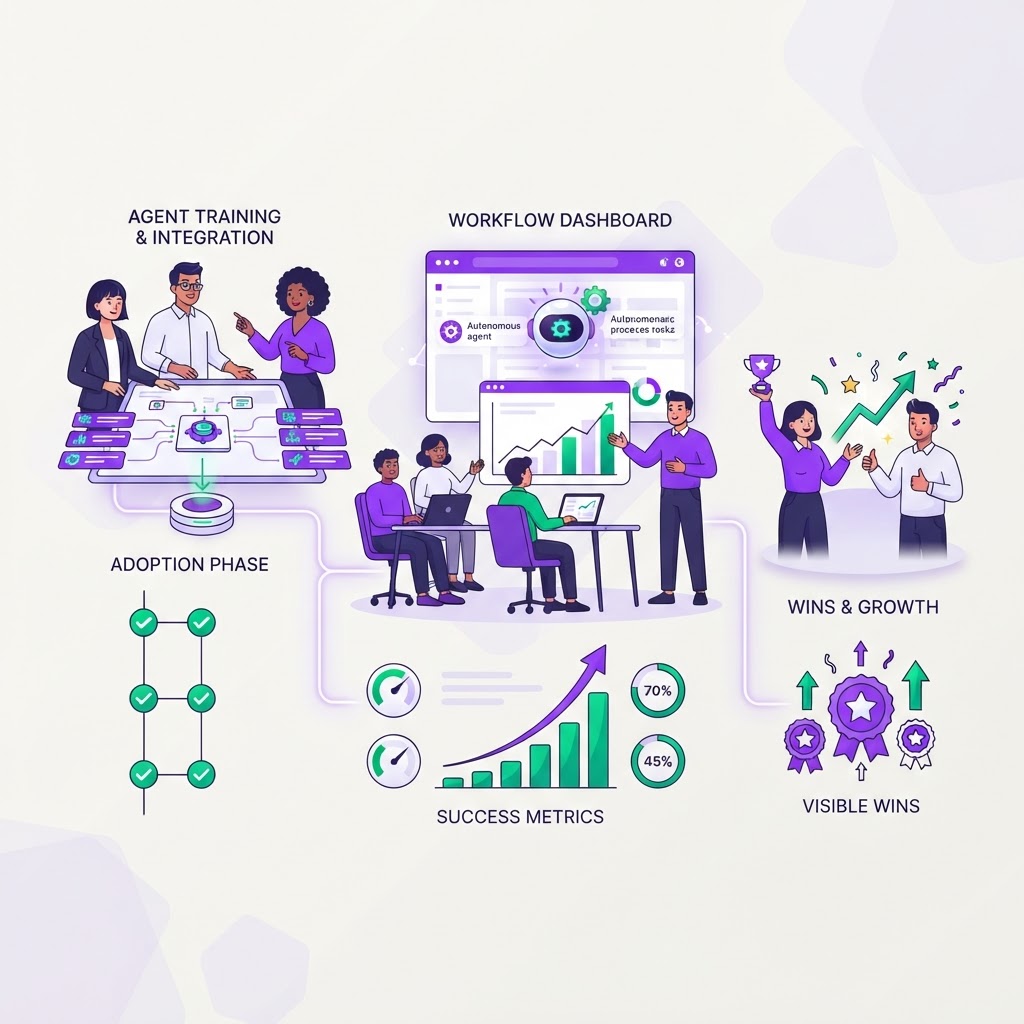
Most Australian SME owners have been sold a false dream: the idea that a single software update will fix their operational bottlenecks. You have likely invested in a CRM, an inventory management system, and cloud-based accounting software. Yet, your team still spends hours manually copying data between these silos. An agentic platform acts as a bridge, sitting across these existing systems via APIs to handle the heavy lifting. The challenge isn't the technology; it is the human element. If your team thinks the new agent is another tool to monitor their performance, they will find reasons to ignore it.
Involve the doers from day one
The biggest mistake leaders make is choosing an automation project in a boardroom and forcing it onto the staff. If you want high adoption, talk to the people who are actually performing the tasks. Ask your logistics coordinator which part of their day makes them want to quit. You need to identify the 'hidden' workflows that never show up in management reports. When the person doing the work helps define how the agent should behave, they stop seeing it as a threat and start seeing it as a personal assistant.
Start with their worst task
Don't attempt a full-scale digital transformation in the first month. Instead, look for the most soul-crushing, manual data-entry process your team currently manages. If your sales representative spends ninety minutes every afternoon manually updating stock levels in the ERP after a sale in the CRM, start there. By automating that specific pain point, you provide immediate, tangible relief. When a team member sees their workload cut by five hours a week, they become your best advocate for further integration.
Tackle job-security fears head-on
Be honest about why you are implementing these agents. If your goal is to reduce headcount, your team will rightfully sabotage the project. If, however, your goal is to scale revenue without increasing your administrative overhead, tell them that clearly. Frame the agent as a tool that removes the 'robots' from the human, allowing them to focus on high-value client relationships and strategy. In a competitive Australian labour market, keeping your best talent focused on meaningful work is a retention strategy, not just an efficiency play.
Measure the right things
Avoid vanity metrics like 'number of logs generated.' Instead, focus on outcomes that impact your bottom line and staff morale. If you can show that the agent reduced the average time to process an order from 20 minutes to two, track that figure visibly. Post the results in the office or on the company Slack channel. When people see that the agent is handling the boring stuff, the fear of the unknown begins to evaporate.
- Track the reduction in time spent on manual data entry per week.
- Report on the decrease in error rates for customer orders.
- Share feedback from clients regarding faster response times.
Create structured feedback loops
An agentic platform is only as good as its configuration. Your team will notice edge cases that the developers missed during the initial setup. Create a simple channel where they can report when the agent misinterprets a command or misses a data field. Treat these reports as product improvements rather than failures. If a staff member suggests a new capability for the agent, implement it quickly. This reinforces the idea that the team is in control of the machine.
Proper training is not just a demo
Watching a two-hour webinar on platform features is the fastest way to kill interest. Training must be task-specific and hands-on. Spend twenty minutes with the person who uses the agent most, showing them exactly how to trigger the workflow and what to do if an exception occurs. Provide them with a simple cheat sheet that covers the three most common scenarios. Confidence comes from knowing how to fix a process when it goes slightly sideways.
- Identify the top three bottlenecks that cause the most rework.
- Set up short, 15-minute 'desk-side' training sessions for power users.
- Establish a dedicated channel for quick questions or bug reporting.
Focus on the layer, not the replacement
Your SME has built a tech stack that works for your specific business needs. The agentic layer isn't here to replace your CRM or your finance software; it is here to make those systems talk to each other. By maintaining the integrity of your existing systems, you lower the risk of total operational failure. This approach allows you to deploy in weeks, not months, which helps maintain momentum. When the transition feels like an upgrade rather than a migration, the team is far more likely to get on board. Managing this change requires transparency, clear communication, and a commitment to making the lives of your employees easier rather than just making your business faster.
Where to start
- Interview three staff members about their most repetitive daily task and calculate the weekly time cost.
- Select one of those tasks to automate as a 'pilot' project that can be completed within 14 days.
- Publicly commit to a 'no-layoff' policy regarding the roles impacted by this automation to build trust from day one.