Building inspections and certifiers: agents for scheduling, reports and follow-up
By Agentic Design
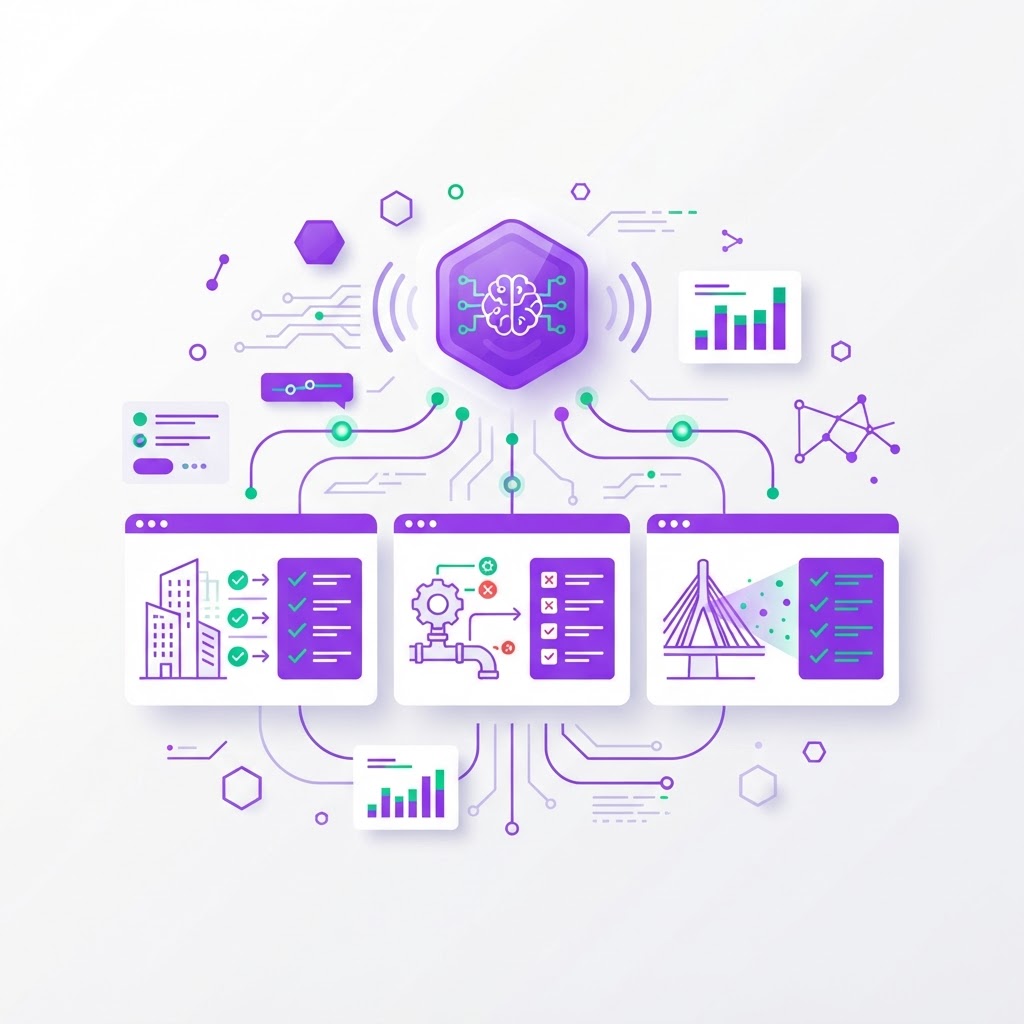
For many Australian building inspectors and certifiers, the core technical work—site assessments, structural checks, and code verification—is often overshadowed by the administrative weight of the business. You spend your mornings juggling calendar conflicts, your afternoons typing up reports from site notes, and your weekends chasing clients or councils for missing documentation. This operational drag limits your capacity to scale and reduces the time you can spend on high-value billable work. Agentic AI platforms offer a way to regain this time without the massive cost or disruption of replacing your current systems.
The agentic layer approach
Many business owners fear that adopting AI means a 'rip and replace' of their current CRM, ERP, or accounting software. This is a common misconception that stalls digital transformation. Instead, an agentic layer acts as a digital intermediary that lives on top of your existing tech stack, using APIs to bridge the gaps between your disparate tools. Whether you use a generic CRM like HubSpot, a construction-specific ERP, or even a messy series of spreadsheets and email threads, an agentic platform connects them into a unified workflow. It does not replace your systems; it acts as the glue that makes them talk to each other, allowing for autonomous task execution.
Automating the booking and route planning cycle
Scheduling site visits is a notoriously inefficient process that usually involves back-and-forth emails, double bookings, and inefficient route mapping. An agentic platform can monitor your incoming requests and check them against your inspectors’ live calendars and current locations. If a new inspection request arrives, the agent can cross-reference the site address with scheduled appointments, calculate the optimal route, and provide the client with an immediate, accurate booking window. This reduces the administrative load by roughly ten hours per week for a mid-sized firm.
- Real-time automated calendar management based on inspector proximity.
- Dynamic route planning that accounts for traffic patterns and site accessibility.
- Automatic updates to clients via SMS or email once a slot is confirmed.
Accelerating report drafting from field data
Writing reports is perhaps the most significant time sink for certifiers. You capture site notes, photos, and compliance data, then return to the office to compile this into a structured document. An agentic agent can ingest your rough field notes and raw photo metadata to generate a compliant, formatted report draft within minutes. By mapping your specific compliance checklists and legislative requirements into the system, the agent ensures that no section is left incomplete. You are then left only with the final review and sign-off, turning a three-hour reporting task into a thirty-minute quality control exercise.
Managing defect follow-ups and compliance
Once a report is submitted, the work of chasing defects often falls into a black hole of missed emails and forgotten phone calls. An agentic system can monitor these outstanding items by pulling data from your report logs and tracking them against project deadlines. It can automatically send polite, firm follow-up reminders to builders or property owners, keeping the project moving without requiring your personal intervention. This proactive stance significantly shortens the time between inspection and final certification.
- Automated monitoring of defect rectification deadlines.
- Intelligent email drafting for council and client correspondence.
- Escalation triggers when compliance timelines are nearing expiry.
Streamlining council and stakeholder correspondence
Building certification involves a constant stream of correspondence with local councils and project stakeholders. Agents can be configured to draft responses to council requests for information (RFIs) by scanning your project folder for the necessary documentation. This ensures that your responses are consistent, professional, and delivered within council timeframes. By delegating this communication, you reduce the risk of clerical errors and speed up the overall approval process for your clients.
Measurable efficiency gains
For a small firm conducting ten inspections a week, the cumulative time saved by these autonomous agents can exceed twenty hours. When you consider the cost of an inspector's time versus the cost of an agentic platform, the ROI is usually realized within the first two months. Because these systems are designed to integrate with what you already have, the deployment period is often measured in weeks, not months. You are essentially hiring a digital admin team that does not take sick leave and is available twenty-four hours a day.
Where to start
Implementing an agentic layer is a structured process that starts with identifying your most repetitive manual task. Do not try to automate everything at once; start with the process that causes the most friction for your team. Here are the first three steps to take:
- Audit your current workflow to find the specific point where data transfer becomes a manual, repetitive process.
- Choose one high-impact area, such as 'report drafting' or 'client follow-ups', as your pilot project for an agentic platform.
- Identify the APIs available in your existing software to ensure your selected agentic tool can read and write data to your current system without manual exports.