Build versus buy for agentic capability
By Agentic Design
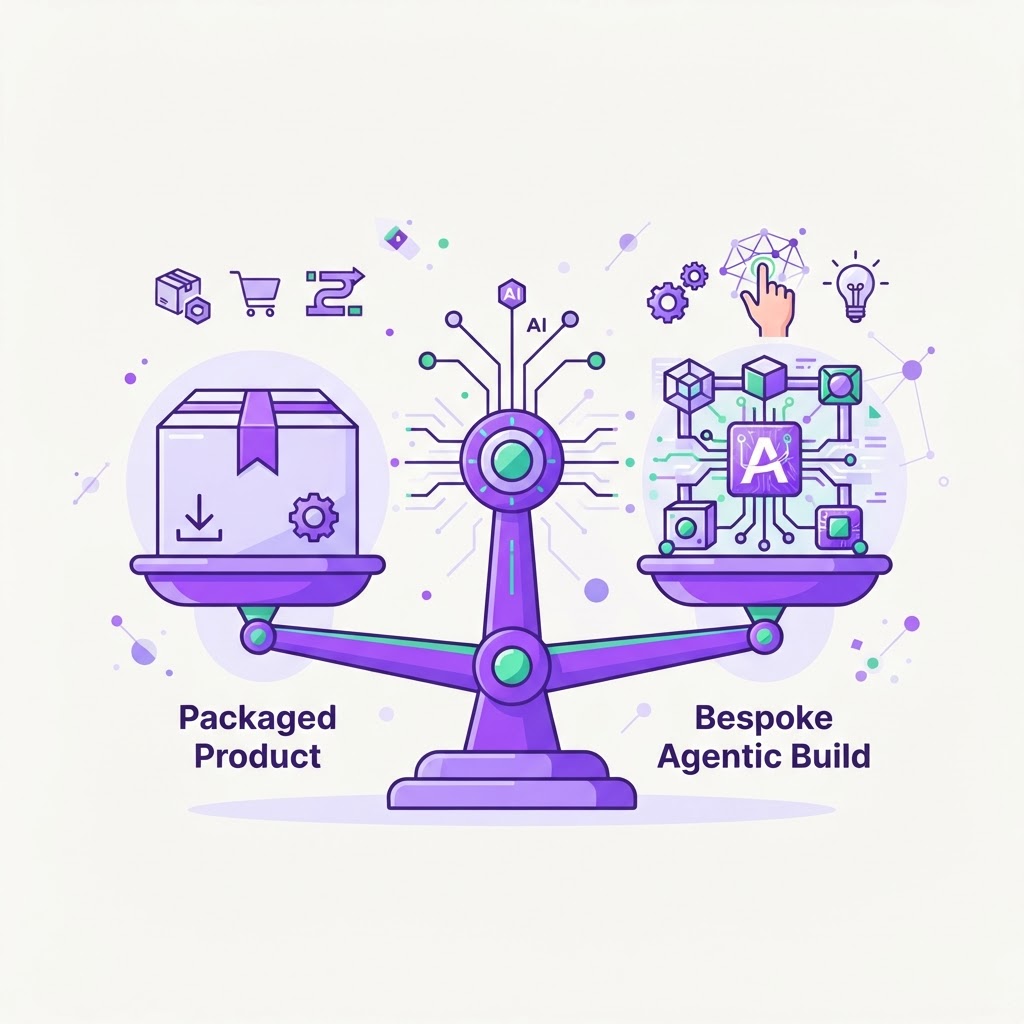
For Australian small and medium enterprises, the decision to 'build' a custom agentic system or 'buy' a packaged AI tool is no longer just about software—it is about how your business processes will function in two years. Many business owners approach us at Agentic Design feeling overwhelmed by the choice between generic chatbots and complex, expensive custom software projects. The reality is that the most effective AI isn't about replacing your CRM or ERP, but building an agentic layer that sits on top of these systems to orchestrate work across them.
When packaged tools are enough
Off-the-shelf AI tools are excellent for discrete, low-risk tasks where your existing software provider has already done the heavy lifting. If your business needs simple summarisation of meeting notes, basic email drafting, or standard sentiment analysis on customer feedback, packaged solutions are usually the winner. These tools are cheap, predictable, and require almost zero maintenance from your team.
However, these tools are inherently siloed. They excel within their own environment but fail the moment you ask them to cross-reference data between your inventory management system and your accounting software. If your goal is to handle high-volume, low-complexity tasks that live within a single application, buying is the practical, low-risk route.
The case for bespoke agentic layers
Bespoke agentic systems win when your operations depend on multiple disparate platforms. Consider a typical Australian wholesale business that needs to cross-reference an order in their Shopify store, a stock level in an ERP system, and a shipping delay notification from a logistics portal. A packaged tool cannot bridge these systems, whereas a custom agentic layer acts as the connective tissue.
This approach doesn't require ripping out your existing tech stack. By using APIs to talk to your existing databases and software, an agentic layer can autonomously trigger workflows that previously required manual data entry. You aren't building a new ERP; you are building an intelligent worker that knows how to operate the ones you already own.
- Automate the transfer of data between your CRM and finance platforms to eliminate manual billing errors.
- Trigger custom replenishment workflows based on real-time stock levels and seasonal demand forecasts.
- Standardise customer communication by pulling context from three different internal systems before generating a response.
Calculating the true cost of ownership
Many SMEs fall into the trap of looking only at the monthly subscription fee of a tool versus the initial build cost of a bespoke agent. This is a false economy that ignores the long-term impact of integration and change. When you buy a packaged tool, your staff often spend hours manually inputting data from that tool into your other core systems, effectively paying twice for the same work.
A bespoke agentic layer costs more upfront—typically ranging from $10,000 to $30,000 for an initial build depending on complexity—but it pays for itself by reclaiming thousands of staff hours annually. When calculating your return on investment, include the cost of the 'human middleware' currently required to bridge your systems.
- Total cost includes the time your staff spends switching between browser tabs to copy data.
- Factor in the risk of human error when manual tasks are performed by tired employees late on a Friday.
- Consider the maintenance cost of training staff on new, complex packaged interfaces versus a bespoke tool that simplifies their current environment.
Avoiding the trap of vendor lock-in
Lock-in is one of the greatest hidden risks for an Australian SME. When you purchase a suite of 'all-in-one' AI tools from a single software giant, you are tethered to their roadmap, their pricing strategy, and their priorities. If they decide to pivot or sunset a feature that your business relies on, you are left with no recourse.
Building an agentic layer is a strategy for independence. By controlling the orchestration logic, you retain ownership of how your business processes are executed. If you decide to switch your CRM or inventory system in the future, you simply update the API connections within your agentic layer rather than migrating your entire business logic to a new proprietary AI platform.
Blended approaches for high growth
Most of our successful clients don't choose a binary path. They use packaged tools for their staff's individual productivity—like basic document editing or calendar scheduling—while investing in bespoke agentic layers for their business-critical, multi-system workflows. This allows your team to benefit from high-quality consumer AI while ensuring your core business logic remains agile and integrated.
This blended strategy ensures that your team is not bogged down by redundant software subscriptions that don't talk to each other. It allows for a phased rollout where you build the most critical orchestration first, delivering tangible ROI within weeks, and then expand the capability of your agents as your comfort level and operational needs grow.
Where to start
- Map your top three manual 'data-passing' tasks where staff move info from one screen to another; this is your immediate target for agentic automation.
- Audit your existing software stack to ensure every core platform provides an accessible API for an agent to read and write data.
- Scope a pilot project that focuses on a single, high-frequency workflow rather than trying to build a 'master' agent that does everything at once.