Beyond the 'Pilot' Plateau: Why Your Agentic Stack Needs a Governance-First Architecture
By Agentic Design
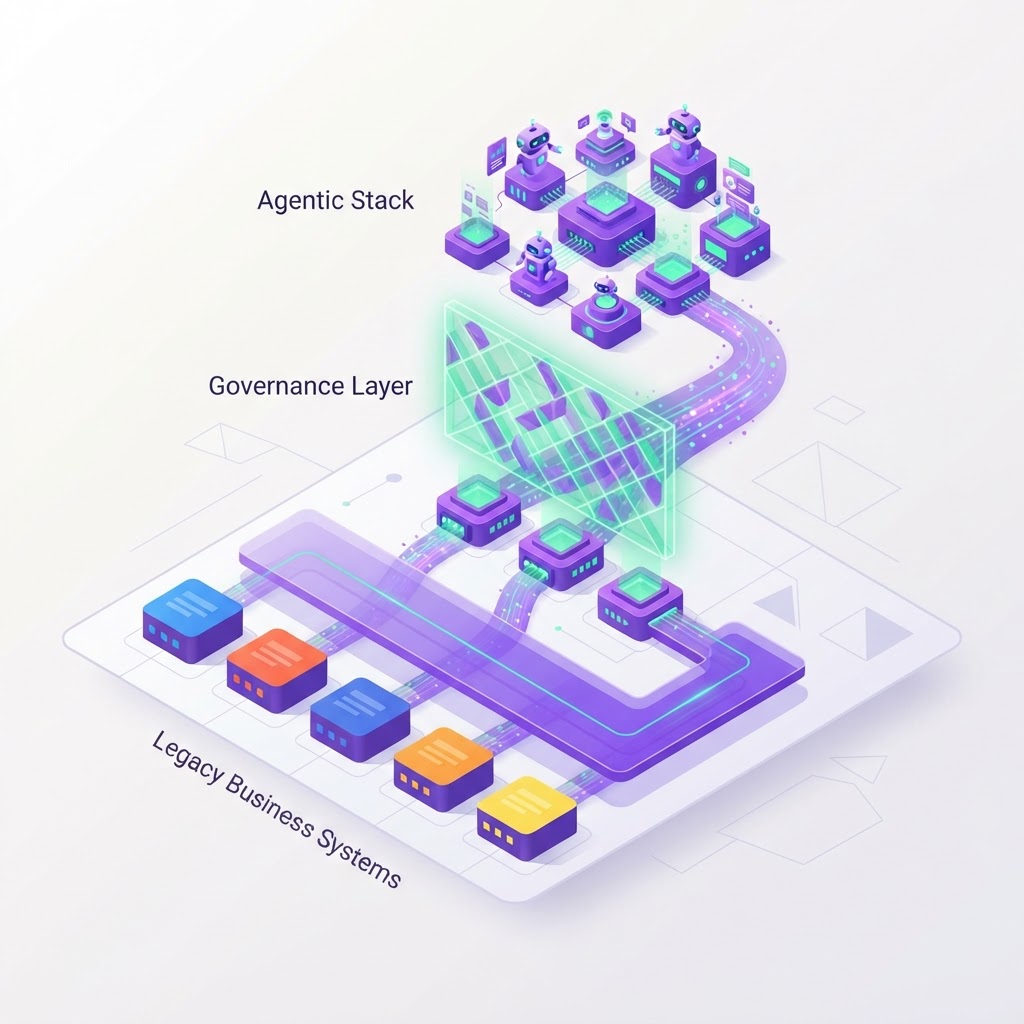
Many Australian businesses have successfully navigated the 'pilot' phase of artificial intelligence. You have likely built a few agentic workflows that summarise meetings, draft emails, or triage customer queries. However, there is a common wall that leadership teams hit when trying to move these experiments into core business operations. That wall is the 'pilot plateau,' where the initial magic fades and the real challenges of reliability, security, and scalability emerge. Moving beyond this point requires a deliberate shift from 'getting it to work' to 'ensuring it stays governed.'
Rethink your architecture
Governance is often mistaken for a handbrake that slows down innovation. In reality, a well-designed governance-first architecture acts as the seatbelt that allows your team to move faster with confidence. When your agents are empowered to make decisions or interact with sensitive systems, you need clear guardrails. Without them, you are essentially flying blind, hoping the black box behaves exactly as expected every single time.
The pillars of robust agent control
To build a sustainable stack, your technical and operational approach should focus on three foundational pillars. These ensure that your agents remain predictable, accountable, and transparent across the entire organisation.
-
Access Control: Strict authentication ensures that agents only interact with the data and tools they are explicitly authorised to touch.
-
Human-in-the-Loop: Critical decisions or high-risk actions should require a manual sign-off to mitigate potential hallucinations or errors.
-
Observability: You must have a centralised dashboard that logs every agent interaction, making it easy to audit decisions and troubleshoot performance issues.
Why local compliance matters
Operating in the Australian market brings unique regulatory considerations, particularly regarding data sovereignty and privacy. Many global AI tools send data to servers halfway across the world, which may not align with your specific industry obligations or the expectations of your local clients. By embedding governance into your stack, you can ensure that data handling is compliant from the ground up, rather than trying to retrofit privacy protections after an incident has already occurred.
Building for long-term resilience
Treating your agentic stack as a product rather than a side project is the mark of a mature digital leader. This means implementing rigorous testing protocols, version control for your prompts and logic, and a clear incident response plan. You wouldn't launch a new business unit without proper management structures, and your AI agents should be treated with the same level of professional scrutiny.
Moving forward with purpose
The goal is not to have the most agents, but to have the most reliable ones. By prioritising a governance-first architecture now, you are building a foundation that will withstand the rapid evolution of the technology. Take the time to audit your current pilot programmes and ask yourselves where the structural gaps exist. With the right guardrails in place, you can turn your AI experiments into a genuine competitive advantage that scales across your entire organisation.