APIs are the only integration you need to start
By Agentic Design
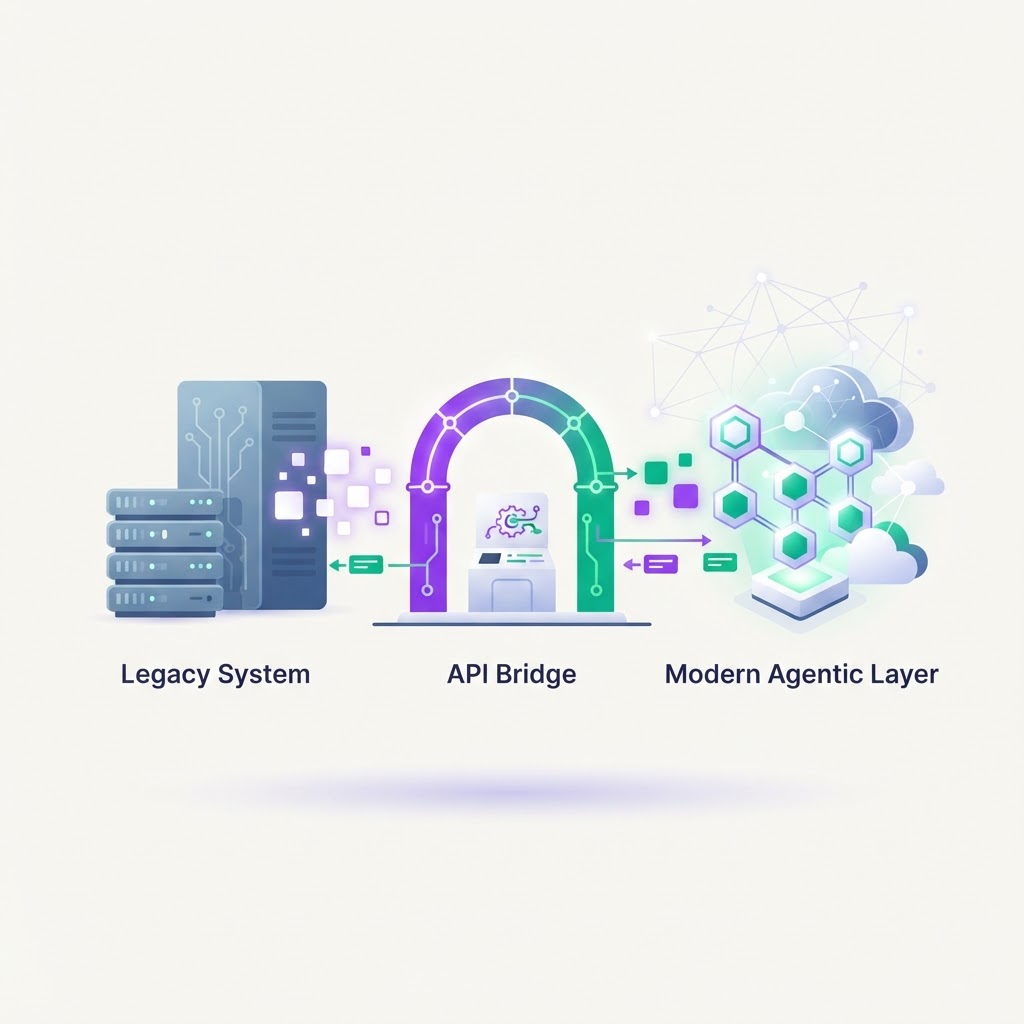
For many Australian SMEs, the ambition to automate workflows often dies on the altar of the 'system migration' project. You are told you need to abandon your current CRM or ERP because it does not talk to your accounting software. This leads to months of downtime, ballooning costs, and the inevitable risk that your new, shiny system lacks the custom features you spent years perfecting in your old one. You do not need to replace your stack; you need to connect it.
At Agentic Design, our core philosophy is that an agentic platform should act as a standalone, intelligent layer that sits across your existing systems. By leveraging APIs, we create an orchestration layer that automates tasks without forcing you to change the tools your staff already know how to use. This approach is not about re-platforming; it is about interoperability.
The API-first advantage
An API—or Application Programming Interface—is essentially a structured language that allows two pieces of software to exchange data. Instead of asking a human to copy data from an email into an inventory spreadsheet, an agentic layer performs this task automatically. By prioritising APIs, you retain the 'source of truth' within your original systems, ensuring that your data remains clean and auditable.
This method keeps delivery timelines short. Because we are not rebuilding your database architecture, we can deploy functional automation agents in weeks rather than months. We simply plug into what you already have, allowing your existing technology to do the heavy lifting while our platform handles the decision-making and cross-system logic.
Start with read-only access
When we onboard a new client, we always start with read-only API access. This is the safest way to familiarise an agent with your data environment. By observing your operations without the ability to change them, the agent learns the patterns, volume, and timing of your transactions.
- Gain visibility into your current workflows without risking data corruption.
- Validate that the API returns the expected data formats before attempting writes.
- Allow stakeholders to audit agent behaviour in a low-stakes environment.
Once the agent accurately maps your business process, we graduate to write-access. This gradual approach mitigates risk and ensures that all stakeholders feel comfortable with the level of automation being introduced.
Scoped credentials and security
Security is often cited as a barrier to automation, but API integrations are actually more secure than manual processes. When we set up an integration, we use scoped credentials. This means the agent is granted access only to the specific data points required for its task, rather than full administrative privileges.
If an agent is designed to manage invoicing, it is given access to your finance platform, but it has no visibility into your HR records or payroll. This principle of least privilege ensures that even if a credential were compromised, the potential damage is strictly contained. For Australian SME owners, this provides a clear, manageable security posture that meets standard business compliance requirements.
Idempotent writes
In automation, the biggest technical trap is the 'duplicate entry' error. Imagine a system error where an invoice is generated twice because the connection flickered. We solve this by using idempotent writes. This is a design principle where multiple identical requests have the same effect as a single request.
If the agent attempts to create a record and the network drops, it checks if that record already exists before trying again. It is a simple concept, but it is the difference between a reliable system and one that causes administrative chaos. We prioritise these safeguards so you can trust the automation without constant oversight.
Dealing with systems that lack APIs
Not every legacy application has a modern API. Occasionally, we encounter older local software or proprietary platforms that are essentially 'black boxes'. When an API is missing, we use alternative methods to bring these systems into your agentic fold.
- RPA (Robotic Process Automation) to emulate human clicks on legacy interfaces.
- Database level integrations where read-only access to the underlying SQL is feasible.
- CSV export orchestration, where the system dumps data that our agent then ingests.
These workarounds are effective, but they are treated as temporary bridges. Our goal is always to move you toward modern, API-driven architectures as you upgrade your tools, ensuring your infrastructure stays lean and performant over the long term.
The speed of incremental value
The real value of an agentic layer is how quickly it delivers ROI. By integrating via APIs, we avoid the 'big bang' implementation model. We can automate your order-to-cash workflow in week two, then move on to inventory replenishment by week four. You are not waiting for a complete digital transformation; you are seeing tangible efficiency gains almost immediately.
In a competitive market, being able to pivot your operations in days rather than quarters is a significant advantage. Your systems should work for you, not the other way around. By adopting an API-first mindset, you gain a scalable, robust, and truly modern business architecture without the headache of a massive platform migration.
Where to start
- Audit your stack by identifying which of your core platforms offer an 'API key' or 'Developer access' in their settings menu.
- Choose one high-frequency, low-complexity task, such as syncing new customer details between your marketing tool and your CRM.
- Request a scoped API key from your software provider specifically for 'Agentic Integration' to test a single, non-destructive read-only connection.