Agentic platforms vs SaaS: why owning the workflow beats renting a feature
By Agentic Design
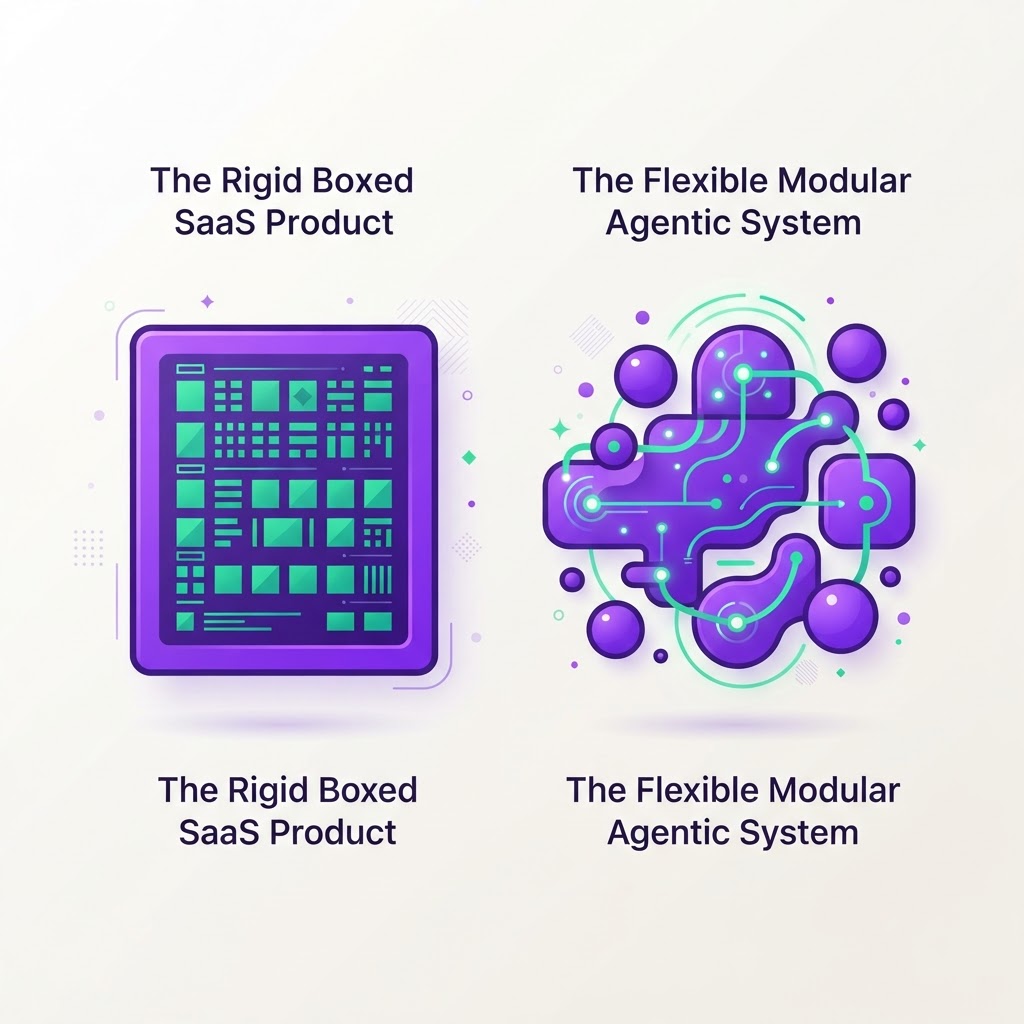
For years, the Australian business landscape has been defined by a 'SaaS-first' mentality. We buy a CRM to manage sales, an ERP to track inventory, and accounting software to manage cash flow. Each of these tools solves a specific problem perfectly, but they rarely speak to each other in a meaningful way. You end up with a fragmented digital infrastructure where your team spends more time copy-pasting data between tabs than actually delivering value to customers.
Traditional SaaS is built on the premise of configuration, not true customisation. If your unique operational workflow doesn't fit the provider's standard template, you either force your business to change its processes or you accept a permanent bottleneck. This is where the shift towards agentic platforms changes the game. Unlike a vertical SaaS product that keeps you trapped inside its specific interface, an agentic platform acts as an intelligent layer that sits above your existing stack.
The fundamental difference: Fit versus configuration
When you subscribe to a SaaS platform, you are renting a feature. You are buying someone else's opinion on how your business should run. If a feature update doesn't align with your requirements, you have little recourse other than to file a ticket and wait for a roadmap update that may never arrive.
An agentic platform operates differently because it is designed to be the connective tissue between your systems. Instead of forcing you to migrate data, it integrates via APIs to read, write, and execute tasks across your CRM, accounting software, and spreadsheets simultaneously. You aren't replacing your existing stack; you are augmenting it with an autonomous layer that understands your business rules.
Consider an Australian logistics SME dealing with order reconciliation. A traditional SaaS setup requires a manual trigger from an employee to move data from a shipment tracker to the accounting system. An agentic platform can monitor those systems in real-time, handle the data entry, flag anomalies for human review, and update the inventory levels without a single keystroke. You own the workflow, not the vendor's limitation.
Speed of change and the cost of roadmap dependence
SaaS vendors thrive on massive, generic updates. They roll out features that satisfy 80% of their customer base, often ignoring the niche, highly profitable requirements of your specific operation. When you rely on SaaS, your agility is limited by the vendor’s innovation speed.
- Your innovation is capped by the vendor’s public product roadmap.
- Customisation requests often sit in a backlog for months or years.
- Business logic is trapped inside proprietary black boxes.
In contrast, agentic platforms are designed to be malleable. Because they operate as an abstraction layer, the logic that defines your business operations lives within the agent's instructions, not deep within the vendor’s codebase. If your procurement process changes tomorrow, you update the agent's logic in hours, not months. This speed of change is a significant competitive advantage in the Australian market, where nimble SMEs can out-manoeuvre larger, slower-moving incumbents.
Rethinking the economic model: Per-seat versus outcome
Traditional SaaS pricing usually follows a 'per-seat' model. This creates a perverse incentive where every time you hire or grow, your operational costs increase linearly. You are paying for access, regardless of whether that user is doing high-value work or simply clicking 'refresh' on a dashboard.
Agentic platforms shift the conversation toward outcomes. You aren't paying for the number of users accessing a screen; you are paying for the execution of a workflow. If an agent manages 500 invoices a week, the cost remains stable regardless of how much your headcount fluctuates. This allows you to decouple your growth from your operational overhead.
However, it is important to be fair: SaaS is still the right answer for commoditised functions. If you need a standard payroll engine or basic email hosting, don't try to build an agent to replace it. Use the best-in-class SaaS tool for the heavy lifting, then use an agentic platform to bridge the gaps between those tools.
Where does SaaS still win?
It would be irresponsible to suggest replacing your entire stack with custom agents. Agentic platforms are not a replacement for reliable, stable, out-of-the-box infrastructure. Use SaaS for foundational systems that have high regulatory requirements, such as:
- Compliance and tax reporting software.
- Core communication and identity management.
- Specialized, high-security financial record keeping.
For everything else—the messy middle of your daily operations—there is a better way. By keeping your core systems stable and layering an agentic platform on top, you achieve the stability of a SaaS product with the bespoke operational agility of a custom-built solution. You gain the ability to scale your operations without scaling your administrative headcount.
Where to start
- Audit your 'copy-paste' tasks: Spend one week tracking every time a staff member moves data between two different software platforms and quantify the hours lost.
- Identify the highest-frequency process: Pick one repetitive workflow that involves at least three systems and holds the highest potential for human error if automated.
- Pilot an agentic layer: Approach your current workflow as an orchestration problem rather than a software selection problem, and look for partners who can deploy an agent to connect those existing APIs within a 4-week window.