Agent stacks: how one platform grows from one agent to a team of them
By Agentic Design
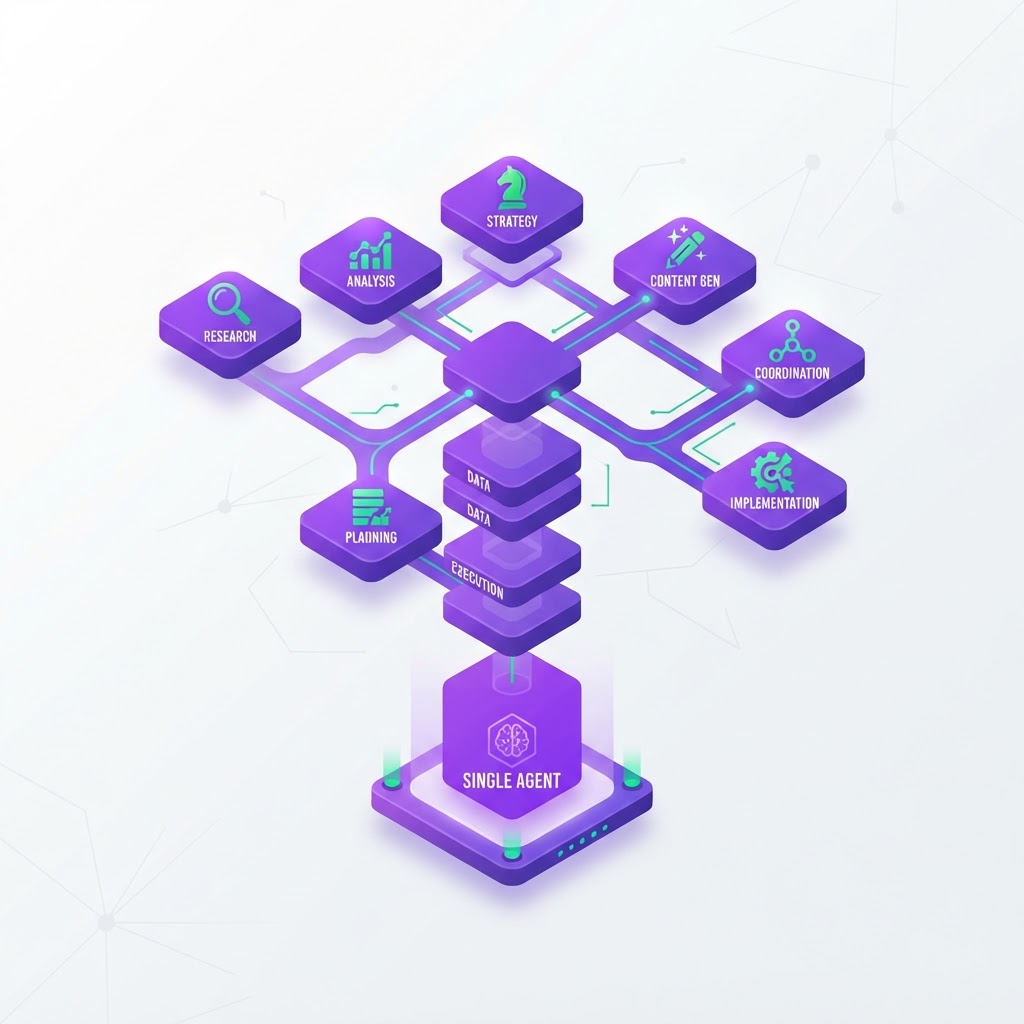
Most Australian business owners look at AI and see a dilemma: do you buy a dozen fragmented tools, or do you wait for a total system overhaul? At Agentic Design, we take a different approach. We build an agentic layer that sits on top of your existing CRM, ERP, and accounting software. Instead of replacing your current infrastructure, we make it talk to itself. This allows you to start small, delivering immediate ROI, before scaling into a sophisticated team of digital agents that function as a cohesive workforce.
The power of the first agent
When we deploy the first agent for an SME, we focus on a high-value, repetitive task. For a wholesale distributor, this might be an inventory-matching agent that scans incoming email orders and updates the ERP database. This single agent eliminates hours of manual data entry and reduces human error in stock counts. It doesn't need to know about your marketing strategy or your HR policies; it just needs access to your email and your ERP.
Because this agent is built on a unified platform, it creates the foundational 'memory' for your future system. It logs how it interacts with the data, documenting the API endpoints and the logic required to handle exceptions. By starting with one agent, you are essentially building the infrastructure for the entire team. You aren't just automating a task; you are establishing the governance and data pipelines that every subsequent agent will use.
Expanding to a team of specialists
Once the first agent is performing reliably, the path to adding a second or third is remarkably short. Suppose your second agent is a customer service lead that handles shipping inquiries. Instead of starting from scratch, it can query the inventory-matching agent to ask about stock levels or status. They now share a common operating language, often interacting via internal platform events rather than constant API pings.
This is where the magic of a platform-based approach truly shines. As you add more specialists, you begin to move away from isolated tasks toward end-to-end process management. A typical team of agents for an SME might look like this:
- The Sales Coordinator: Syncs leads from web forms into your CRM and schedules follow-up tasks.
- The Inventory Scout: Monitors stock levels and triggers purchase orders when thresholds are met.
- The Finance Analyst: Reconciles bank statements against open invoices and identifies discrepancies.
- The Logistics Liaison: Communicates with delivery partners and provides proactive tracking updates to customers.
Each new agent benefits from the context established by its predecessors. By the time you reach the fifth agent, the marginal cost of deployment is a fraction of the first. You no longer need to map out your entire data architecture, because the 'connectors' are already built. You are simply adding new logic to an existing, well-oiled engine.
Orchestration and shared intelligence
When agents start working in a pack, you need an orchestration layer. This is the 'manager' agent that delegates tasks and resolves conflicts. If your Finance Analyst detects an unpaid invoice from a client, it can instruct the Sales Coordinator to pause any new orders for that account until the balance is cleared. This is not a static script; it is a dynamic, intelligent system that understands the business rules of your Australian operation.
Because all these agents operate within the same agentic layer, they can share tools securely. If the Finance Analyst needs to send a custom PDF summary to a client, it doesn't need its own credentials for your document storage; it borrows the secure tunnel already established by the platform. This reduces security risks and makes system maintenance straightforward, as your IT footprint is centralised rather than scattered across five different automation platforms.
Why the fifth agent is cheaper
There is a common misconception that doubling your agents doubles your costs. In reality, the cost curve flattens significantly after the first two deployments. The initial investment in the first agent is heavily weighted toward systems integration and establishing the 'source of truth' for your data. You are teaching the system how to talk to your ERP and your bank.
By the time you reach the fifth agent, the 'heavy lifting' of system integration is finished. You are simply deploying new instruction sets and logic loops. We see SMEs go from a single-task automation to a full-blown agentic team in a matter of weeks, rather than months. The platform approach turns AI adoption from a risky software project into a predictable, modular expansion.
- Integration cost: The majority of the work is done in the first implementation phase.
- Context reuse: New agents inherit the 'institutional knowledge' of previous ones.
- Operational efficiency: The orchestration layer handles hand-offs, reducing the need for human oversight.
- Scalability: Adding specialized skills becomes a configuration task rather than a development project.
Where to start
Do not try to solve your entire business in one go. Start by identifying the single most time-consuming manual bottleneck that requires access to two or more of your existing digital systems. Once you have that first agent running, the infrastructure you have built will support everything else you want to achieve. If you are ready to begin, take these three steps today:
- Map out your most frequent manual data-transfer task that involves an ERP or CRM.
- Verify that your core business tools have API access or a modern integration layer.
- Audit your current manual processes to see where human decision-making is simply following a set of pre-defined rules.