Agent orchestration: when one agent should become several
By Agentic Design
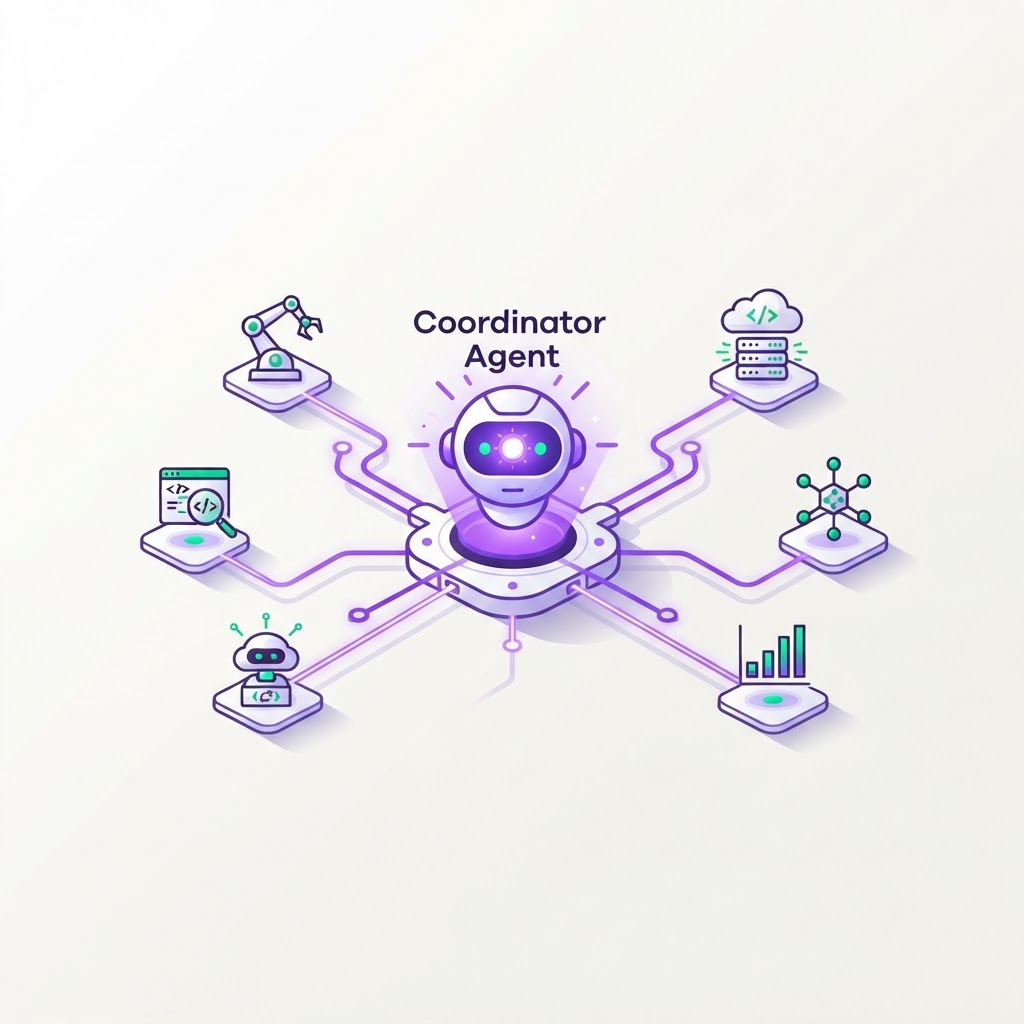
For many Australian SMEs, the initial journey into AI starts with a single, capable agent. You might have one tool that monitors your inbox, processes invoices, and updates your CRM. It works well until it doesn't. When the workload grows or the processes become nuanced, a 'Swiss Army knife' agent starts to struggle with accuracy and reliability. At this point, the question isn't whether you need more AI, but how to structure it.
Signs you need specialisation
The primary indicator that you need to split your agent is a degradation in performance. If your agent is juggling too many distinct roles—like lead qualification, inventory updates, and customer support—it will eventually hit a limit in its processing window or its reasoning focus. You might notice the AI starts 'forgetting' specific constraints or fails to execute complex multi-step tasks consistently.
Another sign is the maintenance burden. When you need to update your sales process, does your developer need to untangle the logic for three unrelated functions just to tweak a single prompt? If a simple change creates cascading failures across your entire operational workflow, your agent has become a monolithic bottleneck. Specialisation allows you to silo these functions so that changes in one area do not destabilise another.
- Your error rate increases as you add more tasks to the workflow.
- You find yourself writing extremely long, fragile instructions to manage conflicting priorities.
- The AI takes longer to respond because it is parsing excessive background data for irrelevant tasks.
The coordinator pattern
When you move to a multi-agent setup, you need a coordinator pattern. Think of this as a project manager who understands the capabilities of their team members. Instead of one agent doing everything, a central coordinator agent receives a request and delegates it to the relevant specialist agent. For an SME, this might look like a 'Traffic Controller' agent that routes incoming enquiries to either a 'Logistics Agent' or a 'Sales Agent' depending on the content.
The coordinator doesn't need to know how to perform the work; it only needs to know who to ask. This keeps your architecture clean and allows for modular scaling. If your logistics needs grow, you can upgrade the logistics agent without touching the sales logic. This approach is highly effective for SMEs that use a patchwork of existing systems, such as Xero for finance or HubSpot for CRM, as it allows agents to act as specialised gateways to those specific APIs.
Shared context and tools
Transitioning to multiple agents does not mean they should operate in isolation. You must maintain shared context so that agents can collaborate effectively. While their logic is split, they must all be able to access the same "source of truth." If a sales agent closes a deal, the inventory agent must immediately know to adjust stock levels without requiring manual input or redundant data entry.
This is achieved through a common data layer within your platform. Rather than letting agents talk directly to each other, they interact with a centralised API layer. This ensures that every specialist agent is looking at the same stock counts, customer history, and financial constraints. By keeping the agents focused on their specific task while grounding them in a unified data environment, you eliminate the "silo" problem that often plagues legacy business systems.
The cost of splitting too early
It is tempting to build a multi-agent system from day one because it sounds sophisticated, but this is a mistake. There is a significant complexity cost to managing multiple agents. Every additional agent introduces latency, requires more rigorous testing, and increases the potential for communication failures between components. If you do not have a well-defined process, splitting agents early just creates a distributed mess.
For an SME, operational simplicity is your greatest asset. You should start with a single, robust agent that handles one clear process from end to end. Wait until that agent reaches a point of high-frequency operation—for example, processing over 500 invoices a week or managing a consistent flow of 100+ daily enquiries—before you consider dividing its duties. Always solve for the immediate business bottleneck first; do not build for a "what-if" scale that you have not yet achieved.
- Increased infrastructure overhead to manage agent communication protocols.
- Difficulties in debugging when a task fails across multiple hand-offs.
- Over-engineering processes that are not yet stable or repeatable.
Where to start
If you are feeling the friction of a single agent reaching its limits, follow these three steps to begin your transition. First, conduct an audit of your existing agent's tasks and rank them by frequency and sensitivity; this will help you identify which function should be the first to be spun off into its own specialist agent. Second, ensure your current agentic platform is properly integrated via APIs with your core systems—CRM, ERP, and finance software—to establish that vital shared data layer. Third, build a simple coordinator agent that handles the initial routing of requests, allowing you to gradually shift responsibilities to the new specialist agent one at a time while keeping the system operational.