A 90-day plan for agentic adoption in an SME
By Agentic Design
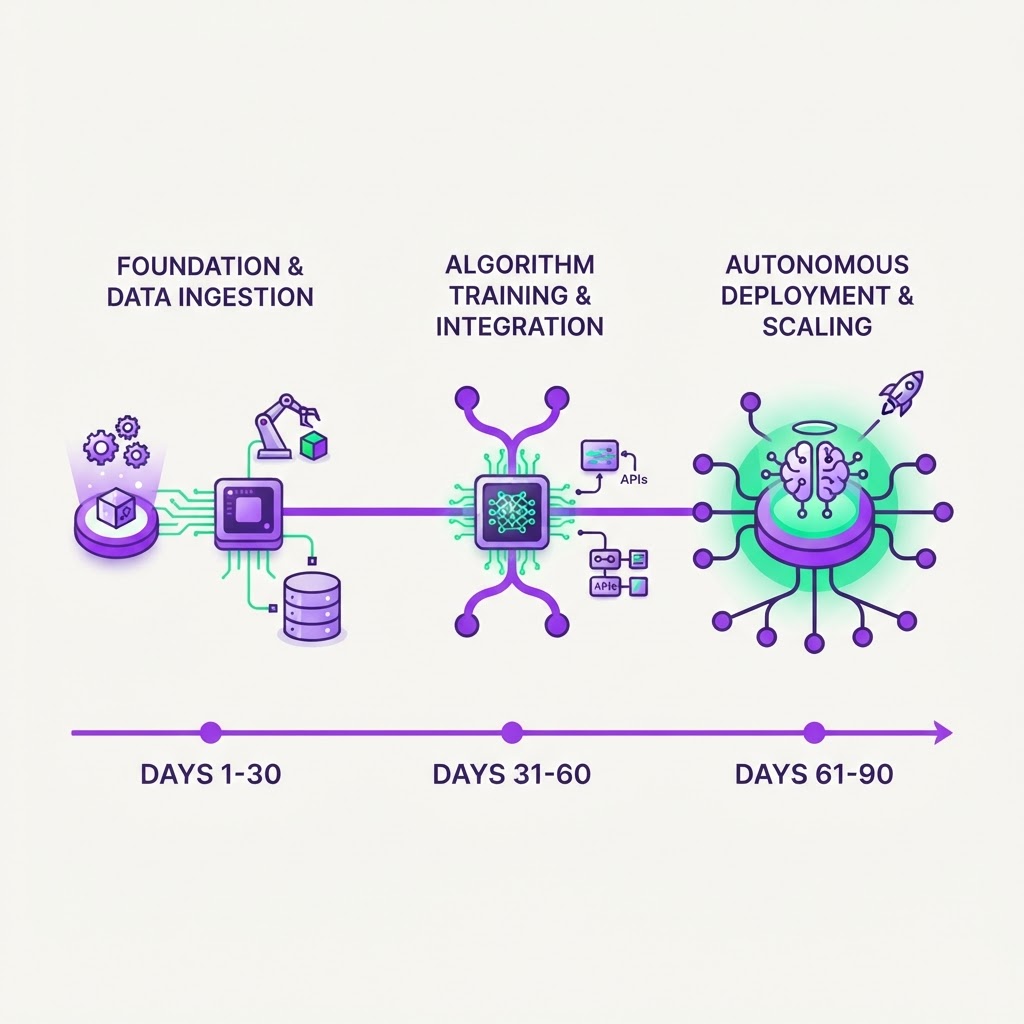
For most Australian SMEs, the promise of artificial intelligence has felt like a choice between expensive, enterprise-level overhauls or superficial chatbots that solve nothing. You do not need to replace your CRM, your accounting software, or your inventory management system to reap the benefits of automation. Instead, you need an agentic layer—a connective tissue that sits across your existing applications, using APIs to perform tasks, reconcile data, and make decisions just like a highly efficient staff member would. This 90-day plan is designed to move your business from manual processes to automated workflows without the typical enterprise bloat.
Weeks 1-2: Discovery and baseline metrics
Your first two weeks should be spent on cold, hard data. Many business owners rush into building agents without understanding the current 'leaks' in their operations. You are looking for high-frequency, low-variance tasks that currently consume your team's time. A classic example is the reconciliation of sales orders from an e-commerce storefront against inventory levels and payment confirmation in your accounting platform. If your office manager spends four hours a week manually checking these three systems, that is a prime candidate for an agent.
To establish a baseline, document the specific inputs and outputs of these tasks. How many minutes does each instance take? What is the current error rate? What happens when a data mismatch occurs? By quantifying these variables, you create a benchmark to measure your return on investment once the agent is live. During this period, the owner must provide technical access to APIs and clearly define the 'rules of the road'—the business logic that the agent cannot violate under any circumstances.
Weeks 3-6: The first agent goes live
By the start of week three, you should move from planning to deployment. We focus on a single, contained task to prove the concept. This first agent should be 'read-only' or strictly bounded to prevent any unintended consequences. For instance, an agent could monitor inbound customer support emails, categorise them by urgency, and pull relevant customer history from your CRM into a draft response for a human to review. You are not handing over the keys to the kingdom yet; you are creating a super-powered assistant for your existing team.
- Select a process that takes at least five hours per week.
- Ensure the task involves clear data inputs from at least two existing systems.
- Define the human-in-the-loop checkpoint where the agent stops and asks for verification.
As the owner, your role here is to test the 'edge cases.' Ask the agent to handle tasks that fall outside the normal workflow to see how it manages ambiguity. You will find that these weeks are about refining the 'persona' of the agent. You are effectively training a new employee; provide feedback on tone, precision, and adherence to your internal business policies. By the end of week six, you should be able to measure a reduction in time spent on the target task. If you started with a four-hour weekly task, aim for the agent to reduce that to thirty minutes of human review time.
Weeks 7-12: The second agent and scale decisions
Once the first agent is performing reliably, you have the confidence to move to a more complex, transactional process. This might involve an agent that triggers inventory reorders based on sales trends or one that automates the follow-up process for overdue invoices. This agent will have write-access, meaning it can update records in your systems. Because you have already built the foundational layer in your tech stack, this deployment typically moves significantly faster than the first.
At this stage, you must evaluate the long-term impact on your workforce. The goal of an agentic layer is not redundancy; it is reallocation. Look at the hours saved in weeks seven through twelve and ask: what could your team be doing if they weren't bogged down in data entry? You are moving toward an operating model where your staff focuses on strategy, customer relationships, and growth, while the agentic layer handles the high-volume, repetitive heavy lifting.
- Review the error logs from the first agent to ensure no drift in performance.
- Assess if the second agent requires additional data sources, such as shipping provider APIs.
- Calculate the total operational savings across both agents to forecast budget for further expansion.
Where to start
If you want to begin this transition today, ignore the buzz and look at your own ledger. First, identify the three most tedious manual processes that require you to copy and paste data between two different software platforms. Second, confirm that these platforms offer public APIs, which most modern Australian SME tools like Xero, Shopify, or HubSpot do. Third, audit your team’s weekly schedules and find the five-hour block that is consistently spent on data-shuffling rather than high-value customer engagement; that is your starting point for your first agent deployment.